
Gold-Plated Electrical Contacts: Benefits, Wear and Design Conditions
Published on September 15, 2026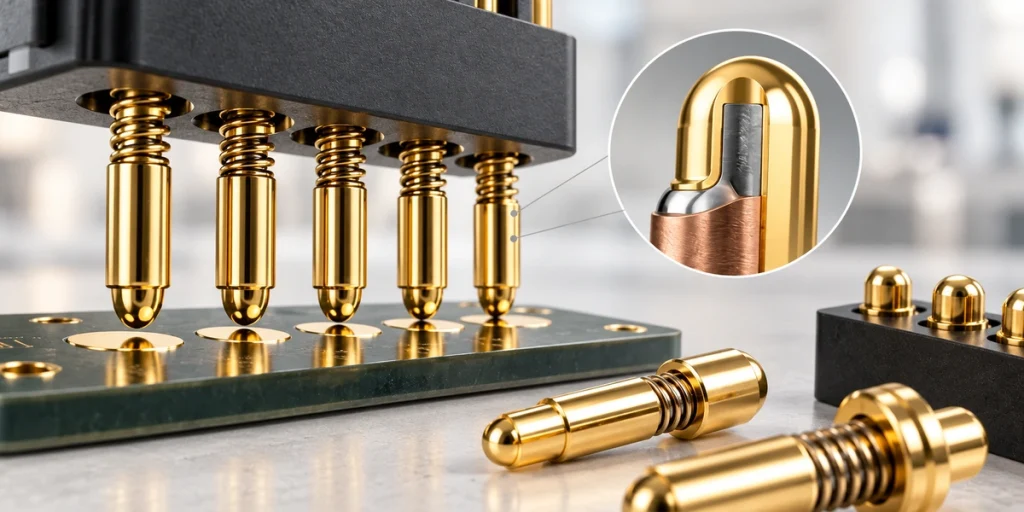
- Why Use Gold on Contact Surfaces?
- Gold and Electrical Conductivity
- The Role of a Nickel Underlayer
- Mechanical Wear of Gold Plating
- Choosing Between Gold and Tin
- Corrosion in a Gold-Plated System
- Gold-Plated Pogo-Pin Interfaces
Gold plating helps electrical contacts resist surface oxidation and corrosion, supporting low, stable contact resistance. Silver and copper conduct electricity better, while gold can provide a stable mating surface for connectors, charging contacts and pogo pins.
Why Use Gold on Contact Surfaces?
Current passes through the small areas where two metal surfaces actually touch. Oxides, corrosion products or contamination at those spots can increase resistance even when the connector remains mechanically mated. Gold's chemical stability makes it less prone to the insulating oxide films formed by many base metals.
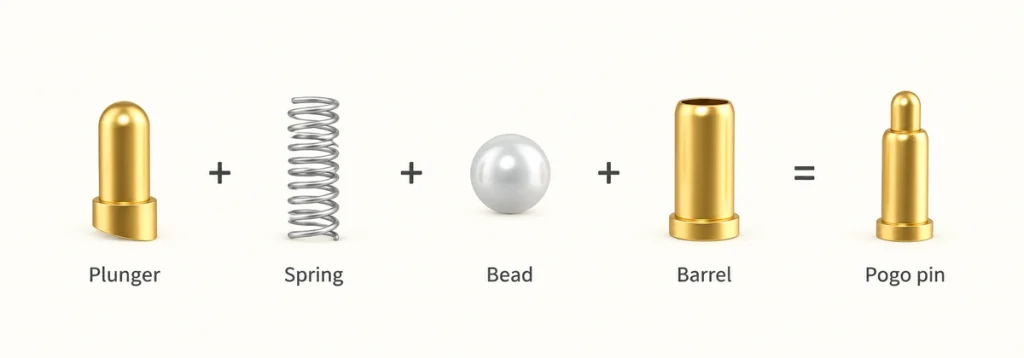
A thin gold finish can provide the mating interface while a copper alloy or another base material supplies conductivity, strength and elasticity. For low-voltage signals, charging current and repeated docking, this combination may help maintain consistent performance during service.
Gold and Electrical Conductivity
Gold has lower electrical conductivity than silver and copper. Copper is consequently widely used in wires, PCB tracks, terminals and connector base materials.
Silver and copper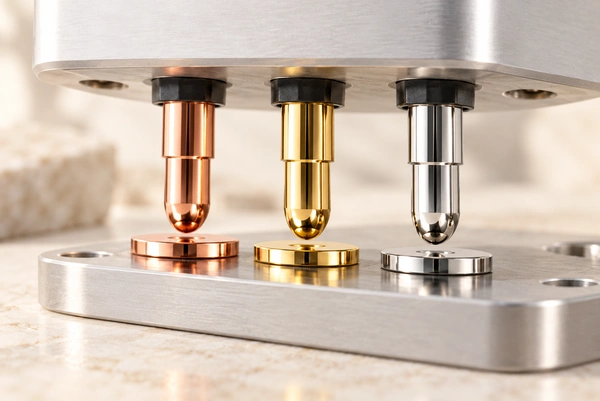
The useful property of gold at a contact is its stable surface. High bulk conductivity cannot fully benefit an interface covered by insulating oxides or corrosion products. A common approach therefore combines a conductive base metal with gold on the mating area where surface resistance matters.
Gold is selected primarily to help preserve the electrical quality of the mating surface; its bulk conductivity ranks below that of silver and copper.
The Role of a Nickel Underlayer
A gold-plated contact generally uses several layers. One common stack is:
Copper alloy or another base metal → nickel underlayer → gold surface.
The base provides strength and conductivity. Nickel forms a barrier between the base and gold, helping limit metal diffusion and support the plating system. Gold supplies the corrosion-resistant outer contact surface.
Assess more than the presence of gold. Nickel thickness, base material, gold thickness, hardness, porosity and coating uniformity all affect performance over time. Similar-looking finishes can have quite different underlying structures.
The Magtor guide to pogo-pin gold plating, thickness, wear and corrosion explores nickel barriers, gold thickness, spring force, mating cycles and operating exposure together.
MagtorPogo Pin Gold Plating: Thickness, Wear & CorrosionMechanical Wear of Gold Plating
Gold plating can wear despite its resistance to corrosion. Mating, compression, sliding and wiping apply pressure and friction to the interface, which can gradually remove material over thousands of cycles.
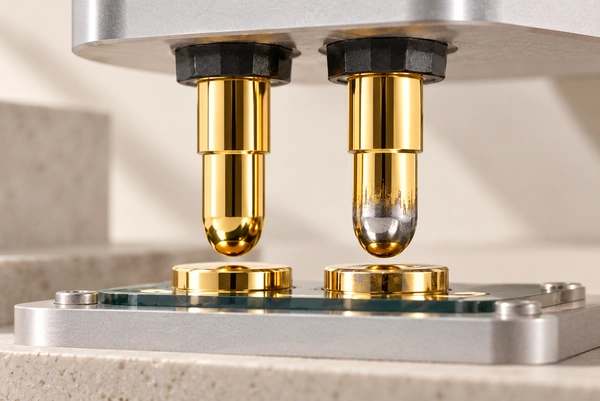
Wear depends on mating cycles, coating thickness, contact force, stroke, alignment, tip shape and mating surface. For repeated mating, a suitable hard-gold finish may resist wear better than soft gold. Small additions of cobalt or nickel can increase electrodeposit hardness and durability compared with pure gold, subject to the plating process.
More gold thickness alone does not resolve over-compression or angled mating. Select the plating and mechanical arrangement together to control premature wear.
For further discussion, see the Magtor guide to pogo-pin gold plating, thickness, wear and corrosion.
Choosing Between Gold and Tin
Gold and tin are common finishes with different application strengths. Gold may suit stable low-level signals, corrosion exposure, frequent mating and electrical consistency over time. Tin costs less as a material and can meet the needs of suitable general-purpose and power connections.
Gold and tin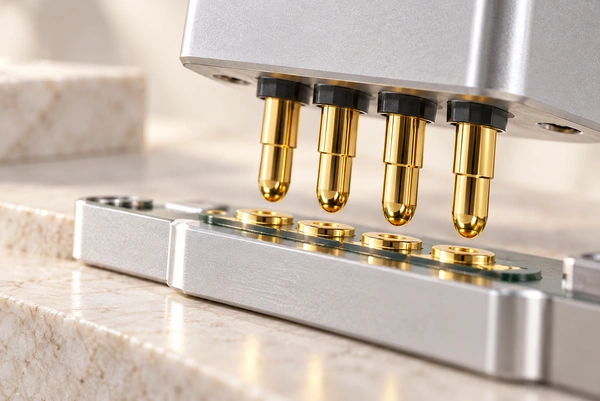
Gold's resistance to insulating oxide formation can help small contact areas. Tin forms an oxide, making suitable contact force and wiping important to the interface. Gold's higher cost should be justified by the application's reliability requirements.
The following qualitative comparison can guide the initial review:
| Selection Factor | Gold Finish | Tin Finish |
|---|---|---|
| Corrosion resistance | Generally high; depends on coating integrity | Depends on the application |
| Stable low-level contact | Can be well suited | More dependent on appropriate contact force |
| Repeated mating | Often selected for this requirement | Depends on the contact design |
| Surface oxide formation | Low propensity for oxide formation | Surface oxide forms |
| Material cost | Higher | Lower |
| Typical applications | Reliability-sensitive signals and charging contacts | General-purpose, cost-sensitive connections |
Scroll horizontally to view every column.
Choose with expected cycles, current, environment, contact force and product life in view. The material's name alone cannot establish suitability.
Corrosion in a Gold-Plated System
A gold-plated system can corrode even though gold itself has strong corrosion resistance.
Pores, scratches or wear-through can expose nickel or base metal beneath the gold. Moisture, sweat, salts and other contaminants can then promote corrosion. Corrosion products formed at exposed non-noble material may spread across the contact surface.
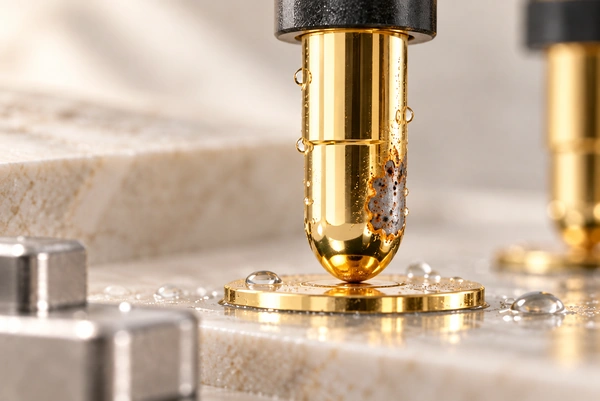
Smartwatches, fitness trackers, TWS earbuds, medical wearables and other sweat-exposed devices need this assessment. Charging cycles contribute mechanical wear, while sweat adds moisture and chloride-containing contaminants. Appearance alone cannot establish whether the plating suits that exposure.
Review gold thickness, the nickel barrier, porosity, wear resistance, mating cycles and corrosion testing together. The Magtor guide to preventing wearable charging-contact corrosion discusses these requirements and possible multilayer or composite plating approaches.
How to Prevent Charging Contact Corrosion in Wearable DevicesGold-Plated Pogo-Pin Interfaces
Pogo pins combine a small contact area with repeated compression. When a product mates or enters its charging dock, the plunger presses against a pad. The interface must retain the required electrical performance while experiencing mechanical wear.
Evaluate pogo-pin reliability across the complete system:
Base material + nickel barrier + gold finish + spring force + working stroke + mating pad + alignment + mating cycles + environment.
A suitable plating specification cannot correct excessive stroke, poor alignment or an unsuitable pad. Good mechanical design can also leave unstable contact if the finish does not suit the required cycles or environment.
Wearable contacts may encounter sweat, skin oils, humidity and cleaning agents. Magtor can assess multilayer or composite plating where greater resistance to sweat and electrochemical corrosion is needed. Review that specification together with spring force, working stroke, current, contact geometry and mating-cycle requirements, then validate the selected configuration.
For spring contacts combined with magnetic positioning, Magtor magnetic cable connector configurations can be reviewed by pin count, current, pogo-pin parameters, magnetic force, cable termination, sealing needs and environment.
Magnetic Cable ConnectorBegin the engineering review with the surface-finish question:
Does this contact have a gold finish?
Then assess the complete interface:
Does the plating and contact system meet the required mating cycles, electrical load, mechanical arrangement and operating environment?
Selecting the Complete Contact System
Gold provides a stable, corrosion-resistant surface that can help keep contact resistance low over time. Its resistance to surface oxidation is valuable at the mating interface, even though other metals have higher bulk conductivity.
The finish still has limits: mechanical wear and pores can expose the layers beneath it. Unsuitable combinations of thickness, force, alignment and exposure may cause early failure.
For pogo pins and charging contacts, assess the whole interface. Gold thickness, nickel underlayer, base material, hardness, mating cycles, spring force, stroke, mating surface, current and environmental exposure together determine the durability requirement and its validation.