
Applications for Higher-current Magnetic Connectors
Published on July 20, 2026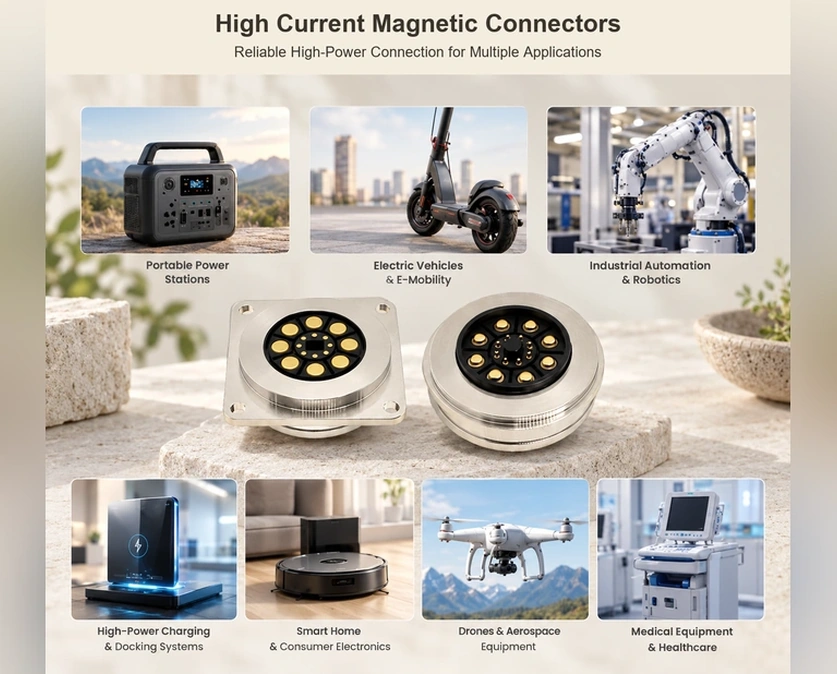
- 1. Portable Power and Energy-storage Equipment
- 2. Electric Mobility and Battery Charging
- 3. Industrial Automation
- 4. Medical and Healthcare Equipment
- 5. Smart Home and Consumer Devices
- 6. Drones and Aerospace Test Equipment
- 7. Higher-power Docks and Charging Stations
- Requirements to Define for Each Application
Higher-current magnetic interfaces combine magnetic guidance with conductive contacts in designs that need frequent attachment and a compact power connection. Their suitability depends on electrical loading, retention, thermal limits and exposure conditions. The following application groups illustrate where an appropriately qualified assembly may be considered.
Higher-current magnetic interfaces1. Portable Power and Energy-storage Equipment
Portable power designs need a connector matched to their output, safety requirements and mechanical life. Possible integration cases include:
Portable power stations.
Battery packs.
Solar energy-storage devices.
Outdoor power equipment.
Emergency power supplies.
Compared with a particular insertion-style alternative, a magnetic design may offer:
Quick attachment and removal.
Less risk of damage from forced insertion when the locating geometry is effective.
Contact stability under the validated vibration and movement conditions.
A mating life matched to repeated use.
An assembly designed and verified for 10–30A may serve a charging interface or battery-expansion module. Confirm whether the rating is continuous or intermittent, the applicable voltage, and the complete cable and return path before using that range.
2. Electric Mobility and Battery Charging
Compact power interfaces can be relevant to the charging systems of the following mobility products, subject to the product’s electrical and mechanical requirements:
Electric bicycles.
Electric scooters.
Wheelchairs.
Personal mobility devices.
Battery charging systems.
Magnetic guidance can make attaching a charging connection easier. IP67 or IP68 versions may address specified dust and water exposure, but verify the tested assembly state and immersion conditions. These ratings alone do not qualify a connector for every outdoor environment or mobility safety function.
Magnetic interfaces3. Industrial Automation
Industrial devices may need repeated power connections under demanding exposure and mechanical conditions. Candidate uses include:
Industrial handheld terminals.
Automated inspection equipment.
Robotics.
Automated guided vehicle (AGV) systems.
Industrial sensors.
Design goals to evaluate include:
Current capacity appropriate to the equipment’s power demand.
Resistance to the specified vibration and mechanical shock.
Quick replacement during maintenance.
Reduced servicing time where the connection arrangement supports it.
Industrial versions may require greater magnetic retention, a reinforced housing or corrosion-resistant plating. Set those requirements from the loads and exposure tests; stronger magnets alone do not establish contact stability.
4. Medical and Healthcare Equipment
Power connections for medical products require device-specific safety and reliability assessment. Possible integration cases include:
Portable medical monitors.
Rehabilitation equipment.
Beauty and healthcare devices.
Battery-powered medical instruments.
Potential design benefits to assess are:
Straightforward attachment for healthcare workers.
Less insertion-related wear during repeated connections.
Electrical contact stability under the qualified conditions.
Compact integration in portable equipment.
For medical use, specify contact reliability, service life and compatibility with the actual cleaning or sterilization process. A magnetic connector is not automatically suitable for sterilization or certified medical use; the complete device and intended process need qualification.
5. Smart Home and Consumer Devices
Some smart products need higher charging current within a restricted enclosure. Examples where a magnetic interface may be considered include:
Smart appliances.
Smart furniture.
Robot-vacuum charging systems.
Higher-power smart devices.
Docking stations.
A suitably located magnetic interface can guide a device onto its dock within the designed capture range. Dock geometry and contact travel must still control alignment and pressure.
6. Drones and Aerospace Test Equipment
Weight-sensitive power and test systems may also consider a magnetic interface, including:
Industrial drones.
UAV charging systems.
Aerospace test equipment.
Remote monitoring devices.
Relevant design goals include:
A lightweight assembly.
A current path compatible with the required charging rate.
Resistance to the specified vibration profile.
Maintained contact during the defined movement conditions.
7. Higher-power Docks and Charging Stations
Where a product uses a docking arrangement, a qualified higher-current interface may be incorporated into:
Fast-charging docks.
Battery-replacement stations.
Equipment charging bases.
Multi-device charging platforms.
Magnetic guidance and spring contacts can support repeated docking. A target of thousands of mating cycles still requires testing at the intended load, alignment, contamination and contact-wear conditions; magnetic construction alone does not guarantee stable current throughout that life.
Requirements to Define for Each Application
Use the application’s electrical, mechanical and exposure requirements to assess these items:
| Requirement | What to verify |
|---|---|
| Current rating | Allowable current at the specified duty cycle, voltage and thermal conditions |
| Contact resistance | Heating, voltage drop and efficiency across the full power path |
| Magnetic retention | Contact stability under the required vibration and loads |
| Water-protection rating | The required exposure tests and protected assembly state |
| Contact structure | Power-path capacity and any supported signal allocation |
| Mating life | Connection-cycle durability under the specified operating conditions |
Scroll horizontally to view every column.
Application Summary
Portable power, mobility charging, automation and healthcare equipment present different requirements even when they use similar magnetic interfaces. A compact, frequently connected power path can benefit from magnetic guidance, but selection should follow the complete device’s load, retention, life and exposure needs.
For a design targeting 10A, 20A or 30A, discuss the full duty cycle and operating conditions with Magtor. Contact geometry, magnetic retention, plating and sealing can be evaluated together for a custom assembly; the stated current target requires model-specific verification rather than an unconditional performance promise.
Magtor