
Sealed Three-contact Magnetic Connectors: Protection and Selection
Published on July 8, 2026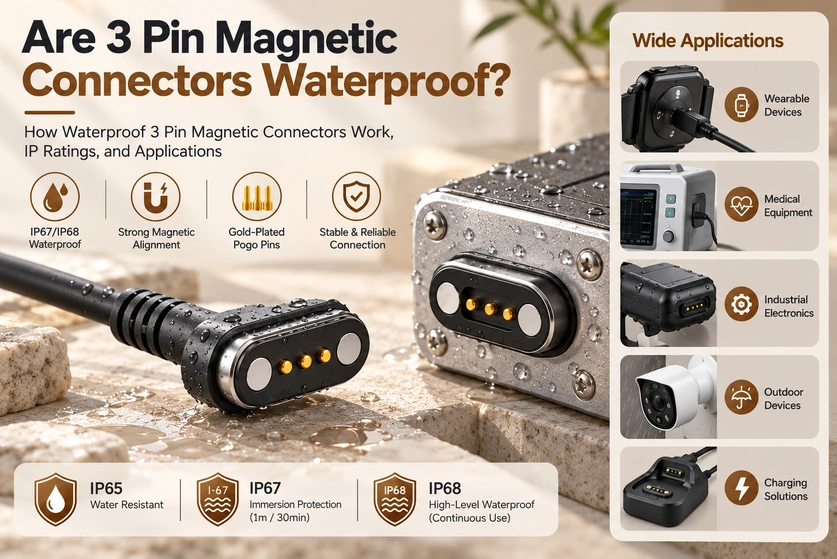
- Features of a Sealed Three-contact Interface
- Interpreting IP Protection
- Application Examples
- What Affects Sealing Performance?
- Immersion and Underwater Operation
- Selection Requirements
A three-contact magnetic interface can use a sealing design, but three pins and magnetic attraction do not establish water protection. For a wearable, medical device, industrial product or outdoor enclosure, review the materials, sealing structure, protected parts and verified IP test state of the specific assembly.
Three-contact magnetic connectorFeatures of a Sealed Three-contact Interface
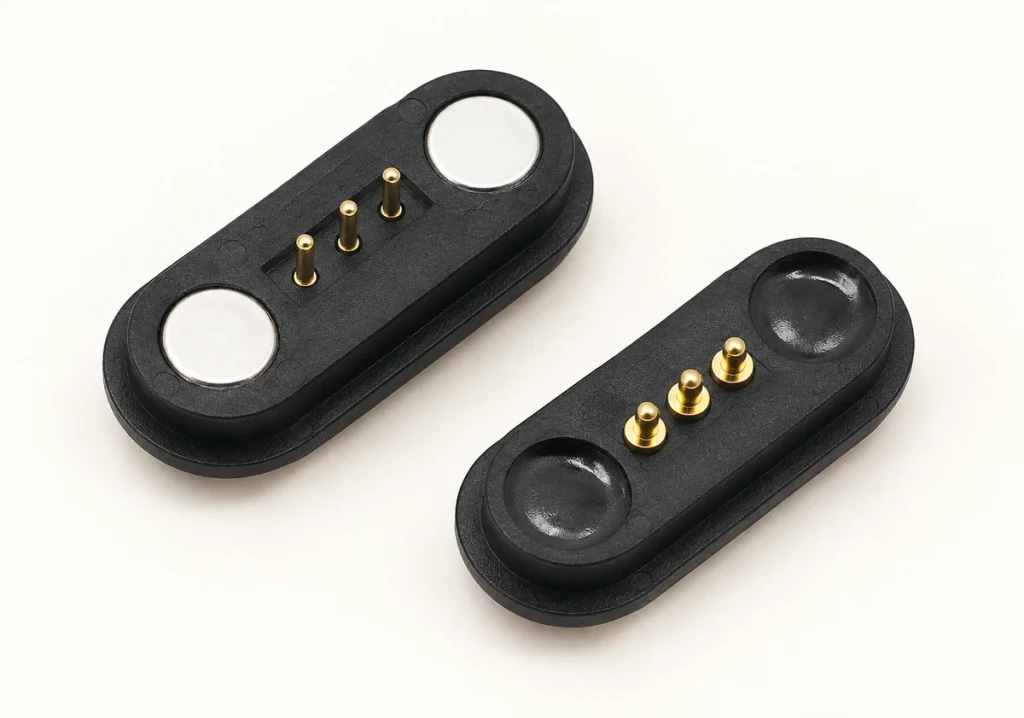
A suitable design may combine features such as:
Silicone sealing rings at the intended ingress paths.
Controlled housing geometry and contact clearances.
A contact-coating system, including gold where appropriate, selected for stable conduction and corrosion exposure.
Magnetic and mechanical alignment that maintains the specified seated position.
Compatible adhesive or overmolding at cable terminations where required.
These measures address different risks. Sealing limits ingress at protected areas, while contact coatings and engagement address electrical behavior and exposure; they are not interchangeable proof of protection.
Interpreting IP Protection
An IP code describes a tested degree of enclosure protection. Request the relevant report and the exact assembly configuration instead of treating waterproof as an unlimited property.
| IP target | Protection conditions to verify | Application examples |
|---|---|---|
| IP65 | Dust-tight and protection against the specified water-jet test | Industrial equipment with a matching exposure requirement |
| IP67 | Temporary immersion; the source example is up to 1m for 30 minutes, with the exact test setup to be verified | Wearables and handheld devices with the appropriate validated assembly |
| IP68 | Immersion under specified agreed conditions; it is not unrestricted protection | Medical or outdoor equipment whose actual exposure matches the test |
Scroll horizontally to view every column.
Verify the claimed rating with testing of the relevant connector or complete enclosure. Reports should identify the parts, mated state, installation and exposure conditions that were evaluated.
Application Examples
A suitably sealed three-contact arrangement may be considered for moisture-exposed or regularly cleaned equipment such as:
Smart wearables.
Medical monitoring equipment.
Industrial handheld terminals.
Outdoor LED lighting.
Robotics.
Portable test instruments.
Charging docks.
Marine electronics.
Quick attachment may be useful in these products, but reliable operation depends on the actual power, signal, cleaning and environmental requirements.
What Affects Sealing Performance?
Review the following factors when assessing protection against water:
magnetic connector1. The Protected Structure
A sealed housing can protect its enclosed parts more effectively than an unprotected opening. Identify which contacts or halves remain exposed and which areas the rating covers.
2. Mating Position and Compression
Magnetic guidance and locating features can help achieve the intended seated position. Verify the seal compression and engagement across tolerances; stronger magnets alone do not prove a tight seal.
3. Materials and Coatings
Select plastic grades, any stainless components and contact coatings for the actual exposure and wear. Their corrosion behavior needs suitable evidence rather than a general high-quality label.
4. Operating Exposure
Salt water, chemicals, high-pressure washing and repeated temperature changes can affect materials and sealing over time. Include these conditions in the requirements separately from a basic water-ingress rating.
5. Maintenance
Keep contact faces and seal areas clean using the approved unpowered method. Contamination control supports engagement, while worn or damaged sealing parts need inspection and the specified replacement procedure.
Immersion and Underwater Operation
IP67 or IP68 test evidence may establish resistance to the stated immersion conditions, but it does not automatically approve live submerged operation or wet mating. Use an interface underwater only when that operating mode, the exposed contacts and the complete system are specifically designed and validated for it.
Marine, diving and underwater-robotics projects may require a custom sealing and electrical-protection arrangement. Define depth, time, contaminants and operating state before discussing an interface; no ordinary magnetic connector is assumed suitable for those conditions.
Selection Requirements
Provide the following information for selection:
Required IP protection, test conditions and assembly state.
IP protectionCurrent, voltage and electrical protection needs.
Mating-life target.
Corrosion exposure.
Operating temperature.
Cable sealing and termination method.
Applicable industry qualification requirements.
Whether a standard or custom structure is needed.
Matching the assembly to the actual exposure helps control failures and maintenance. Confirm the benefit through the relevant test results and service requirements.
Conclusion
A three-contact magnetic interface can provide the required water protection when its sealing, materials and installation are appropriate and tested. IP67 and IP68 are possible targets for suitable wearable, medical, industrial or outdoor assemblies, not automatic properties of three contacts. Verify the report, protected parts, test state and environmental suitability before selecting the connector, especially where immersion or live wet operation is involved.