
4-Pin or 5-Pin Magnetic Connector: Choosing the Right Contact Count
Published on August 6, 2026
- What does a four-pin magnetic connector provide?
- What does a five-pin magnetic connector add?
- Four pins and five pins: design differences
- Benefits and limitations
- Comparing production cost
- Choosing the contact count
Four contacts can suit a compact power interface with basic signals. A fifth provides another assignable contact for functions such as sensing, identification or control. Start with the required pinout, including ground and return paths, then compare the space and complexity of suitable designs.
What does a four-pin magnetic connector provide?
A four-pin magnetic connector has four conductive contacts, with magnets assisting engagement and retention. Typical uses include charging, low-voltage supply and basic signal transmission in compact electronics; the actual electrical capability comes from the specified interface.
4 Pin Magnetic Connectorsignal transmission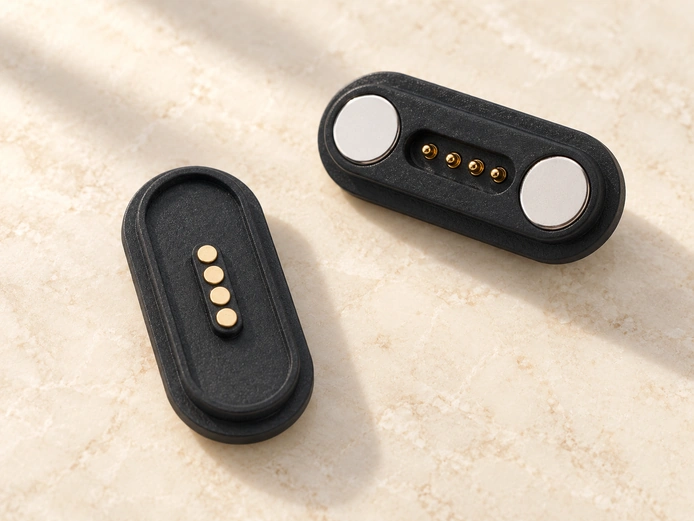
Operating principle: Magnets assist alignment and hold the halves together. This can reduce the force needed for engagement, while resistance to wear or damage depends on the geometry, release direction and tested operating conditions.
Typical structure: Four spring contacts or pogo pins, a housing with magnets, insulating parts and plated mating surfaces form the interface. The housing and finish must suit the required alignment and electrical conditions.
spring contactsPotential applications: Wearables, handheld electronics, smart-home products, charging docks, medical devices and small industrial equipment. These are design possibilities rather than evidence of qualification for every application.
WearablesDesign benefit: Where four contacts cover the power, return and signal functions, the layout can offer a compact and relatively simple solution. Size and cost still depend on the selected construction.
Four-pin video illustration: not currently available.
What does a five-pin magnetic connector add?
A five-pin design adds one conductive contact compared with a four-pin layout. That contact can be assigned to data, identification, sensing, an additional ground or control, provided the complete circuit has the required return paths and electrical support.
5 Pin Magnetic Connectorground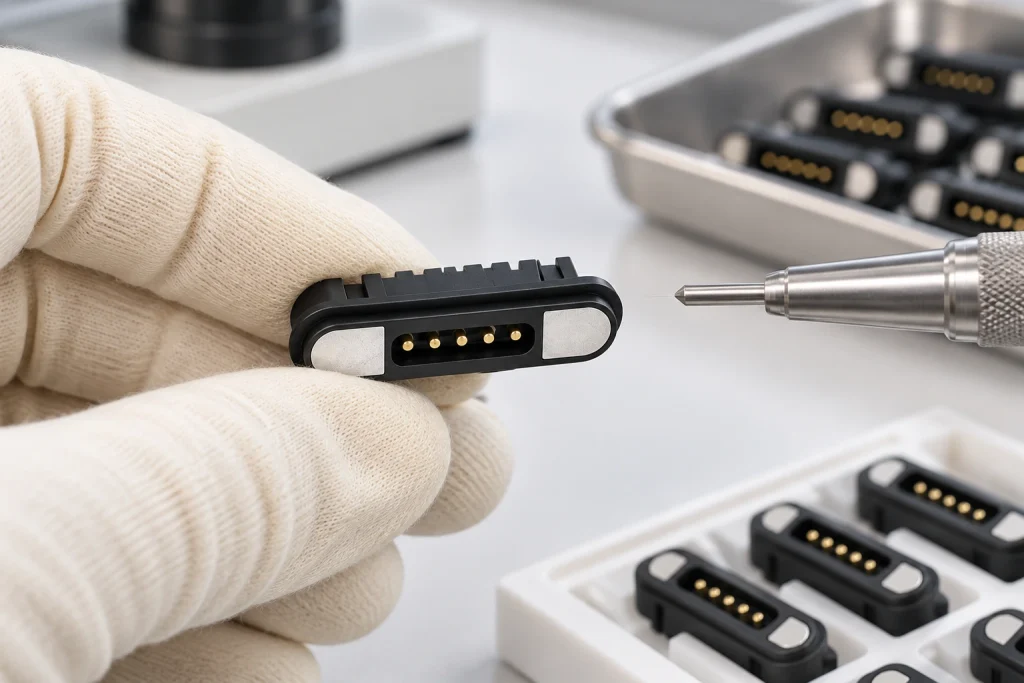
Operating principle: Magnetic alignment works in much the same way, while the fifth contact gives the designer another pin-assignment option. It does not automatically increase current capacity, data speed or protocol support.
Typical structure: Five spring contacts or mating pads, embedded magnets and a protective housing use controlled spacing and assembly tolerances to establish the mating position.
Potential applications: Smart charging, wearables with additional functions, communication modules, IoT hardware and docking stations where the circuit needs another sensing, control or signal contact.
IoTDesign benefit: A fifth contact can make the functional allocation more flexible. Convenient magnetic engagement remains possible, while safe powered connection and controlled release require their own design and validation.
Five-pin video illustration: not currently available.
Four pins and five pins: design differences
| Comparison Factor | 4 Pin Magnetic Connector | 5 Pin Magnetic Connector |
|---|---|---|
| Number of Contacts | 4 conductive pins | 5 conductive pins |
| Best For | Power and basic signals, where the complete pinout fits | Power with an additional assigned data, sensing or control contact |
| Connector Size | May be smaller for otherwise comparable designs | Size depends on pitch, housing and contact layout |
| Design Complexity | Potentially fewer routes and conductors to manage | Another pin-assignment option with corresponding circuit planning |
| Cost | May cost less in a comparable construction | An extra contact can add cost; obtain like-for-like quotations |
| Functional Capacity | Charging and communication supported by the specified pinout | Useful when the circuit requires a fifth contact |
| Reliability | Requires suitable ratings, alignment, pin mapping and validation | Requires suitable ratings, alignment, pin mapping and validation |
Scroll horizontally to view every column.
Design note: Use four contacts if they cover the required charging and basic signals. Add a fifth when it serves a defined function, such as identification, temperature sensing, communication or feedback; count the necessary grounds and return paths as well.
Benefits and limitations
| Feature | 4 Pin Magnetic Connector | 5 Pin Magnetic Connector |
|---|---|---|
| Pros | Can be compact and simple when four contacts meet the requirements | Adds an assignable contact for a required signal or function |
| Cons | Available contacts may limit additional functions | An extra conductor and associated circuitry can increase complexity or cost |
| Best Use Case | Charging or basic signals in space-constrained devices | Charging with additional sensing, control or communication |
| Space Efficiency | Compare the actual four-contact housing dimensions | Compare the actual five-contact housing and PCB footprint |
| Engineering Flexibility | Limited to the functions that fit the four-contact pinout | Offers one more contact to assign, with return paths considered |
| Cost Efficiency | May suit simple high-volume products; confirm the actual quotation | Useful when the fifth contact’s benefit justifies its cost |
Scroll horizontally to view every column.
Comparing four-pin and five-pin production costs
Fewer contacts can reduce material, soldering and tooling requirements in otherwise similar designs. That can favour a four-pin solution, but it is not a universal price rule.
A five-pin design can introduce costs associated with:
An additional pogo pin
More complex wiring
Additional PCB routing
The dimensional tolerances required by the chosen layout
More inspection requirements
Tooling, cable length, magnetic-force requirements, plating and order quantity can be substantial cost drivers in a custom design. Compare quotations using the same requirements rather than attributing the price difference only to one extra pin.
How to choose the contact count
Consider four contacts when:
Four contacts cover all assigned functions, including power and return paths
Compact size is a priority
PCB space is limited
The device requires basic power and signal transmission
Lower cost is important
Consider five contacts when:
An additional control or detection function is required
Power and multiple signals must be transmitted simultaneously
Future functional expansion is expected
The device requires more flexible pin assignment
Connector space is not the primary limitation
Make the decision from a complete pin-function table, the current and signal requirements, available enclosure space and the environment. Compare actual model specifications against those requirements.
Conclusion
Choose four contacts when they meet the electrical needs within the available space and budget. Choose five when the additional contact has a defined purpose in charging, sensing, data or control. Neither contact count establishes better performance on its own.
Frequently asked questions
1. What changes between a four-pin and five-pin magnetic connector? The five-pin design provides one additional conductive contact. Its assigned role may be data, sensing, ground or control; a complete circuit still needs the appropriate return paths.
2. Is five-pin always the better choice? No. It is useful when the circuit needs the additional contact. A four-contact design may be simpler when it already covers charging and the required signals.
3. Can a four-pin magnetic connector carry data? Yes, if the pin assignment and electrical design support the intended interface. Pin count alone does not specify a data rate or compatibility.
4. What applications can use four-pin connectors? Examples include wearables, charging docks, handheld devices, smart-home products and other compact electronics. The selected model still needs application-specific verification.
5. What applications can use five-pin connectors? They can suit smart charging, IoT hardware, docks and communication modules that require an additional sensing, control or signal contact. The circuit determines which functions are supported.
6. Which option costs less? Four contacts may reduce material and wiring costs in a comparable construction. The actual price also depends on materials, finish, tooling, cable and production quantity.
7. What should I compare before choosing? Review the required pin functions and return paths, available space, current and signal requirements, durability targets and production budget against actual connector designs.