
Why a Smartwatch May Use a Magnetic Interface Instead of USB-C
Published on September 8, 2026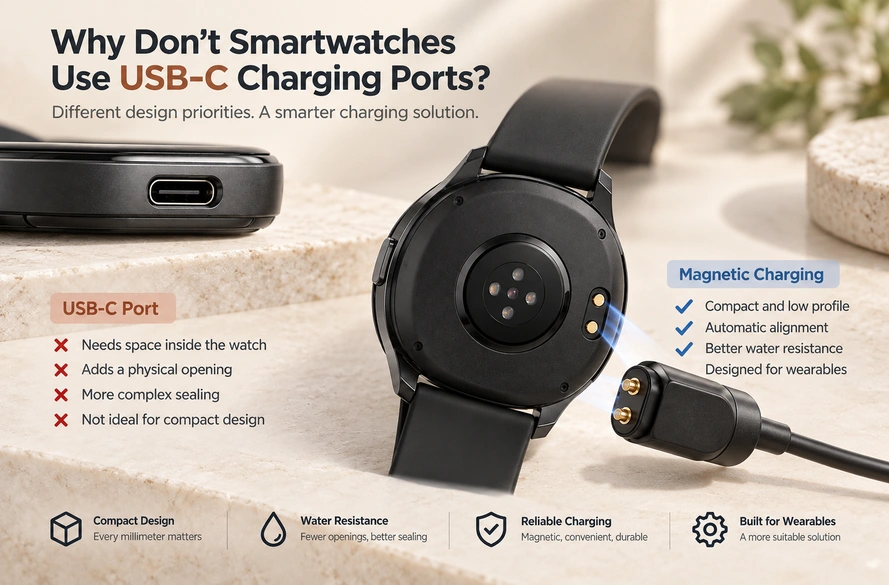
- Why a Watch May Omit a USB-C Port
- Space Needed for a Receptacle
- Water Protection and Exposed Contacts
- Two Magnetic Charging Architectures
- Comparing the Interface Options
- USB-C at the Source and at the Watch
- When a Watch Could Use USB-C
- Selecting the Watch Interface
Many smartwatch designs prioritize space, enclosure geometry, water protection and convenient docking differently from phones. They may use magnetic inductive charging or pogo contacts at the watch while keeping USB-C at the cable's power-source end.
Why a Watch May Omit a USB-C Port
USB-C provides a compact standardized framework for power and data, subject to the complete implementation. Putting a receptacle in a watch requires more design work than cutting an opening in its case.
The battery, display, PCB, antennas, sensors, vibration parts and other electronics compete for a small enclosure. A USB-C receptacle adds PCB area, mechanical support, insertion clearance and a housing opening.
USB-IF describes Type-C as a connector for thinner, smaller products, with a form smaller than the earlier Standard-A and Standard-B connectors. A watch design still needs to weigh those benefits against the receptacle's required space and support structure.
USB Type-C specification from USB-IFFor some charging-only watches, external contacts or an inductive interface may leave more useful internal volume, though coils, magnets and electronics still occupy space.
Space Needed for a Receptacle
The issue is not a universal judgement that USB-C is too large. Watch packaging makes each millimeter part of the design trade-off.
A typical port needs PCB mounting or connection, an enclosure opening, surrounding structural support and clearance for repeated plug insertion.
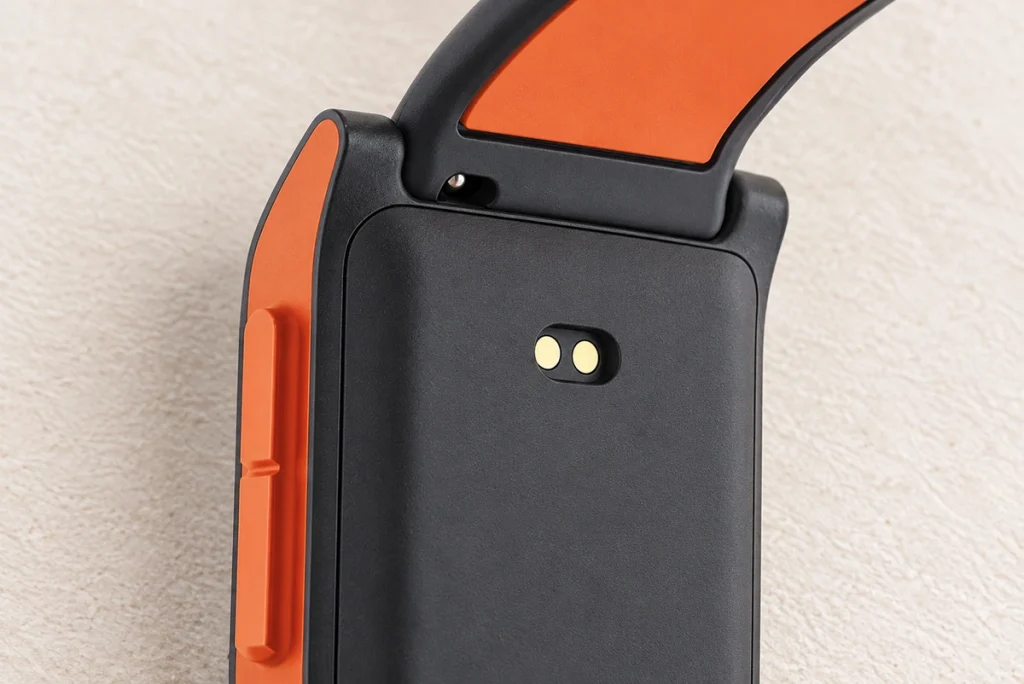
A magnetic contact design can put relatively flat pads on the watch and leave the spring pins in the cable head or dock.
This can favor a magnetic charging interface developed around the watch housing instead of an added plug-in receptacle. The two-contact smartwatch cable guide discusses that design approach.
magnetic charging interface designed around the smartwatch enclosureTwo paths can often carry power and ground for charging alone. Identification, communication or control may call for additional contacts and the corresponding circuitry.
Water Protection and Exposed Contacts
Water-resistant electronics can include USB-C. Their protection comes from the integrated, validated enclosure design rather than a universal waterproof property of the connector.
A receptacle is another mechanical interface to integrate and protect against water, sweat and contamination.
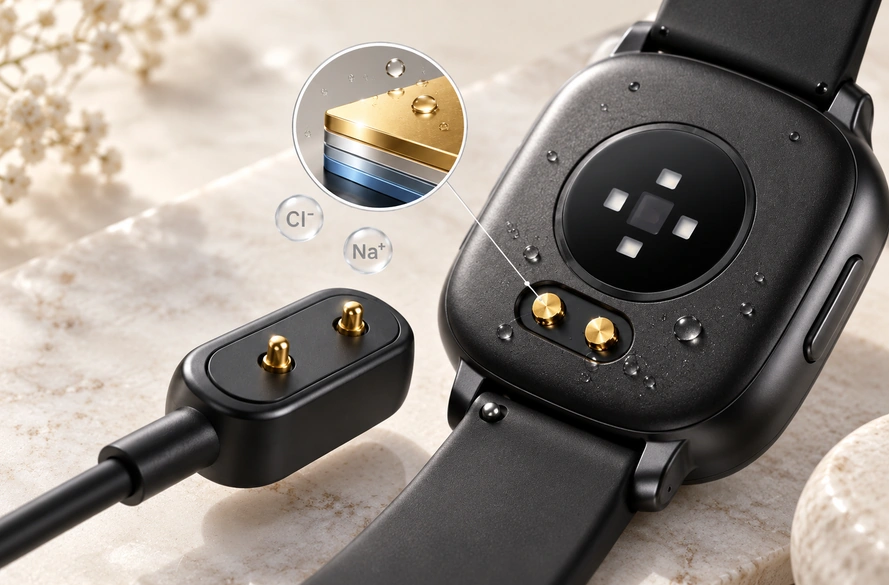
Magnetic contact charging can use surface pads without a plug extending deep into the watch. Inductive magnetic charging can avoid exposed conductive charging contacts entirely.
Surface contacts still face their own risks from repeated sweat, moisture and skin deposits.
Treat enclosure sealing and contact protection as separate, coordinated requirements. The Magtor wearable corrosion guide discusses plating, sweat, electrolysis and contact geometry in long-term charging reliability.
preventing charging contact corrosion in wearable devicesTwo Magnetic Charging Architectures
Magnets can assist docking by guiding the head toward its intended position, provided geometry, orientation and loading allow it.
Distinguish these two arrangements:
Magnetic inductive charging uses magnets for positioning and coils for energy transfer, without a conductive pin-to-pad power connection.
Magnetic pogo charging uses magnets to align conductive spring pins with matching device pads so power flows through physical contact.
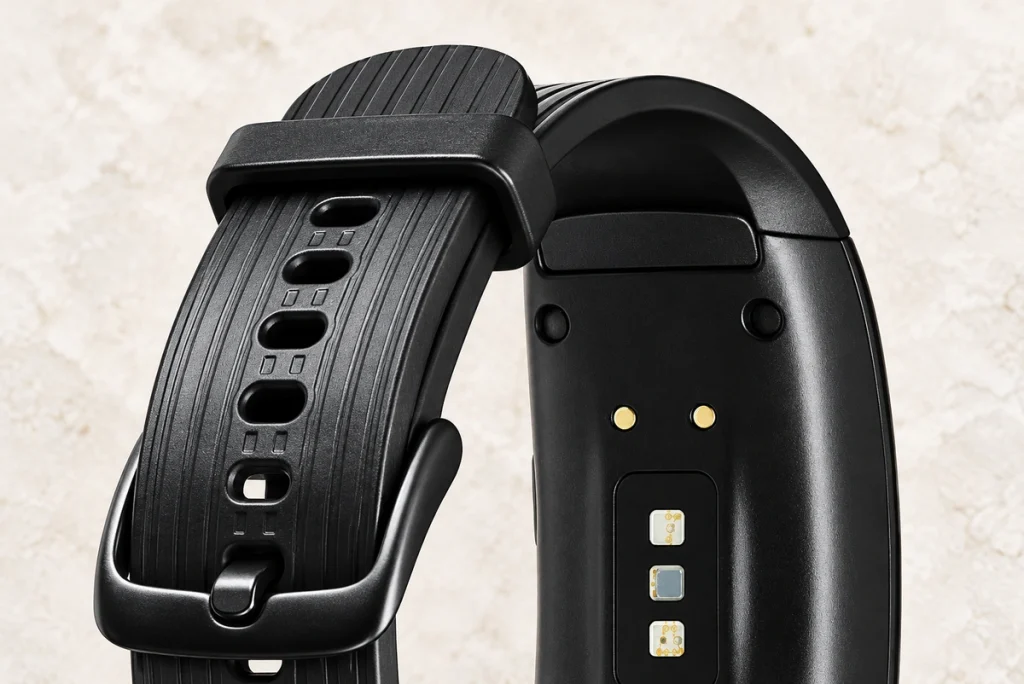
A reference smartwatch model’s accessory specifications provide a specific example: a magnetic pin charger with a USB-C source connection. The watch-side contacts and source-side Type-C connector have different roles; this description should not be generalized to every reference smartwatch generation.
For charging alone, a 2 Pin Magnetic Charging Cable can assign its contacts to power and ground while magnets guide the mating parts.
2 Pin Magnetic Charging CableA typical conductive route is:
USB-C or USB-A power source → cable → magnetic head → pogo contacts → smartwatch pads.
Design benefits can include:
Guided alignment
No conventional plug entering the device
Compact device-side pads
Frequent docking and removal
Configurable spacing and magnetic retention
Integration with a custom wearable housing
Magnetic heads are not automatically interchangeable. Match pitch, polarity, voltage, current, magnet orientation and working height to the watch.
Comparing the Interface Options
Each option addresses different requirements; none is universally preferable.
| Feature | USB-C | Magnetic pogo contacts | Magnetic induction |
|---|---|---|---|
| Standardized interface | Established standardized ecosystem | Usually custom | Usually device-specific |
| Charging | Supported by a suitable system | Supported by a suitable system | Supported by a suitable system |
| High-speed data | Available with suitable electronics and cable | Possible with suitable contacts, cable and electronics | Usually not its main purpose |
| Automatic alignment | Not inherent to the plug | Possible with a matched magnetic design | Possible with a matched magnetic design |
| Physical device receptacle | Required | Usually unnecessary | No electrical receptacle |
| Exposed electrical contacts | Within the receptacle | Present | Absent |
| Customization | Within the standard framework | Highly configurable | Depends on coils and system |
| Frequent docking | Plug insertion | Magnetic attachment | Magnetic attachment |
Scroll horizontally to view every column.
USB-C can be useful where standardized power and data connections are priorities, with capability defined by the system and cable.
Consider magnetic spring contacts when priorities include:
Compact integration, guided docking, repeated connection, custom housing geometry or charging alone.
The Magtor comparison of magnetic cable and traditional connectors examines these mechanical and electrical trade-offs further.
Magnetic Cable Connector vs Traditional ConnectorA broad comparison asks:
Is magnetic charging preferable to USB-C?
For engineering selection, ask:
Which interface fits this device's mechanical, electrical and environmental requirements?
USB-C at the Source and at the Watch
A USB-C cable end does not establish a watch-side Type-C receptacle.
Cable naming can obscure the distinction between its two ends.
The reference manufacturer’s USB-C Magnetic Fast Charging Cable instructions describe a USB-C source plug and a magnetic puck for compatible reference smartwatch models. Those specified accessories and models determine the charging arrangement, rather than the name implying a Type-C port on the watch.
USB-C Magnetic Fast Charging CableThe reference smartwatch 5 accessory description separates the ends as well:
Magnetic pin charger to USB-C.
Both examples illustrate this distinction:
A USB-C power input need not put a USB-C socket on the watch.
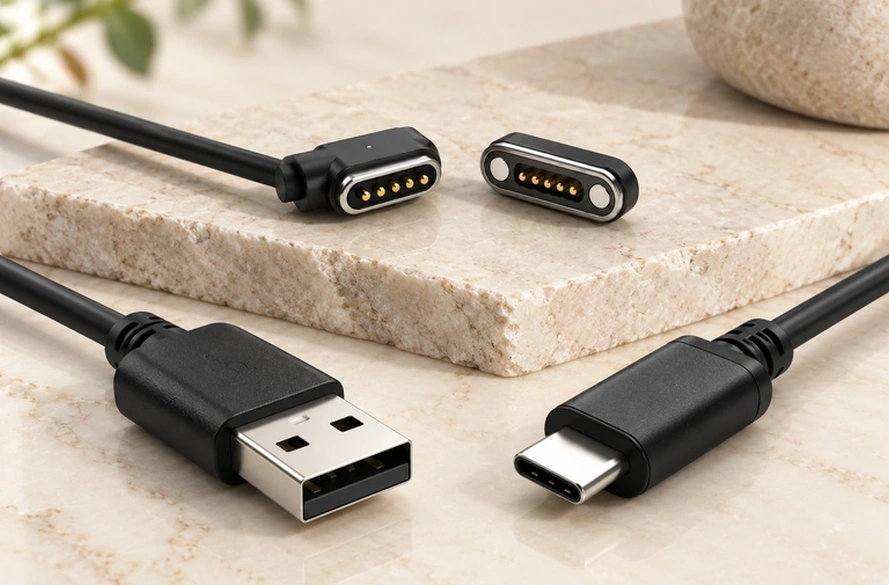
A product can combine a standardized Type-C adapter connection with a wearable-specific magnetic device interface when both are designed appropriately.
Magtor can use that general arrangement in custom magnetic assemblies: USB-A, USB-C, terminal wires or another source end, paired with a device-side magnetic pogo interface.
When a Watch Could Use USB-C
A watch can be designed with a USB-C receptacle; there is no blanket technical prohibition.
The USB-IF Type-C Cable and Connector Specification, including its Release 2.5 document entry, provides the standardized framework for compact electronic interfaces.
USB Type-C cable and connector specificationWhether to adopt that port remains a product-architecture decision.
Balance:
Enclosure thickness
Available PCB and battery space
Water protection requirements
Charging power
Data-transfer needs
Expected mating cycles
Industrial design
The user's charging experience
Regular wired data transfer can strengthen the case for a standardized port compared with a watch needing periodic charging alone.
For charging-only wearables, a simpler two-contact magnetic design may be more practical if its requirements are met.
Selecting the Watch Interface
Start from device requirements, rather than choosing Type-C or magnetic charging because a connector is popular.
If only DC charging is required, V+ and GND may be sufficient. A two-contact magnetic cable can then offer a compact interface with guided alignment.
2 Pin Magnetic Charging Cable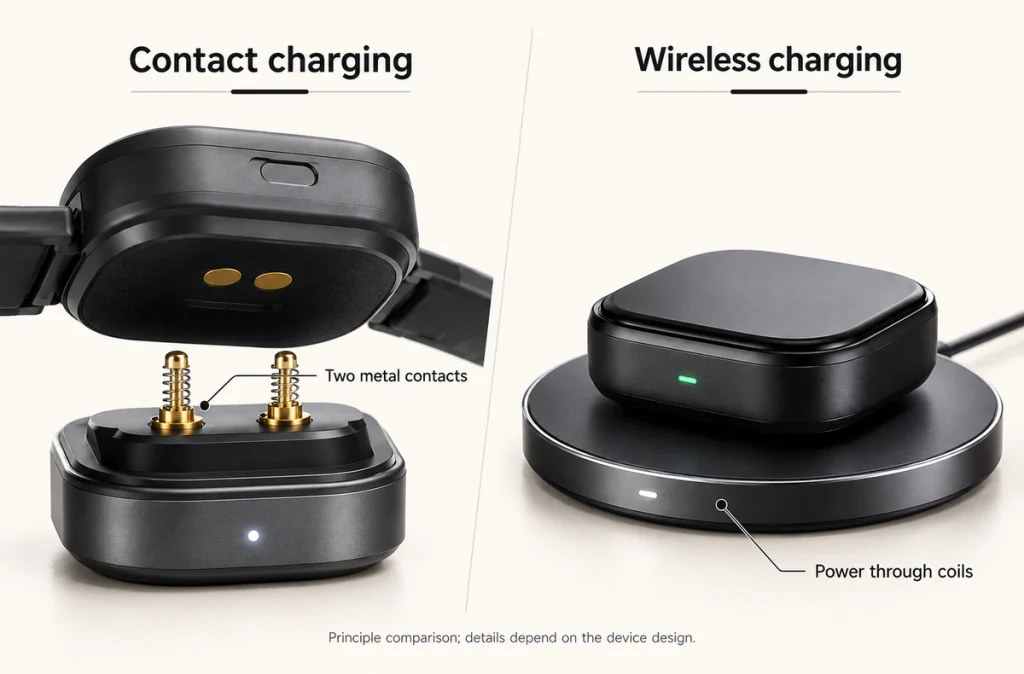
Data, identification or control may need further paths. A custom Magnetic Cable Connector can vary contact count and source termination to suit the circuit and mechanical layout.
Magnetic Cable ConnectorReview at least these seven points for an OEM watch:
Space: establish the volume and layout available for the interface and PCB.
Power or power plus data: two contacts may suit basic charging, while additional functions need the appropriate paths and electronics.
Sweat exposure: specify plating and electrochemical corrosion protection for regular perspiration contact.
Water protection: coordinate the interface with the enclosure's sealing strategy.
Mating cycles: validate changes in spring force, working stroke and finish through repeated charging connections.
Magnetic guidance: match force and orientation for positioning without excessive mechanical load.
Source termination: choose USB-A, USB-C, bare wire or another connection for the product architecture.
Develop the cable around the watch instead of forcing its enclosure to fit an arbitrary charger. The Magtor Magnetic Cable Connector Selection Guide covers contact count, current, routing, retention and environmental demands.
Magtorchoosing a Magnetic Cable Connector for a deviceKeeping the Two Ends Distinct
Watch interfaces reflect packaging and use priorities that often differ from those of phones and laptops. That does not make USB-C unsuitable for modern electronics.
A Type-C receptacle brings a standardized power-and-data framework, with implementation-dependent capability, alongside space, enclosure integration and manual insertion requirements.
Magnetic inductive and conductive pogo arrangements offer alternatives for guided docking, compact interfaces and integration around a wearable enclosure.
The same product can use Type-C at the power source and a magnetic interface at the watch. These are separate parts of its charging path.
A two-contact cable may suit charging alone with power and ground. Where further power, data or identification paths are needed, configure a multi-contact magnetic assembly for the complete electrical and mechanical design.