
Choosing a 2 Pin or 4 Pin Magnetic Charging Cable
Published on September 2, 2026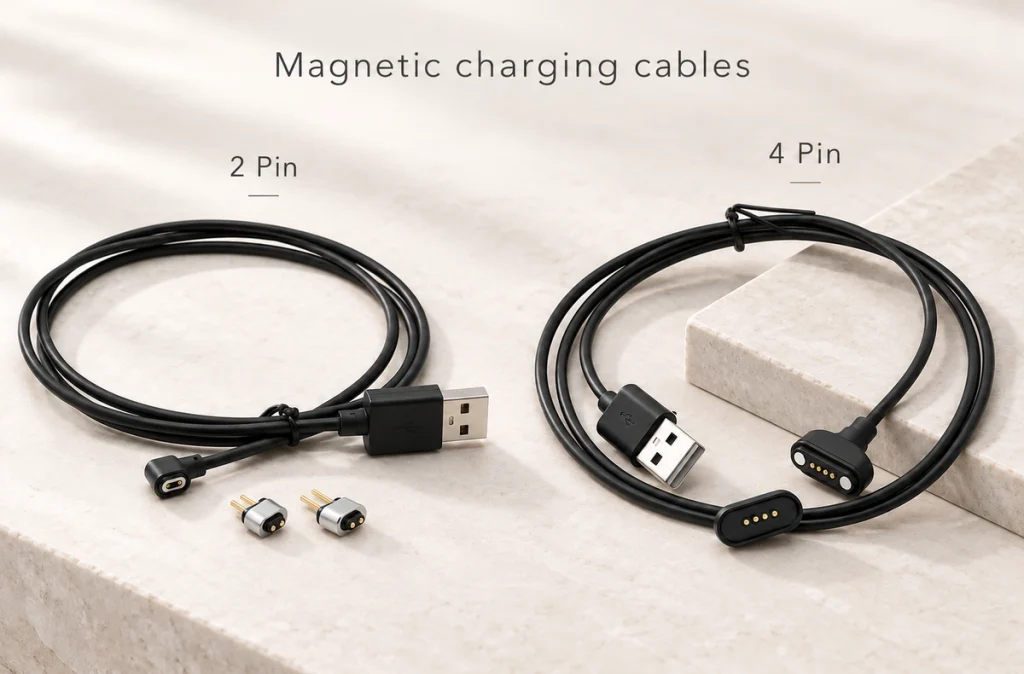
- Comparing the Available Electrical Paths
- Example Pin Assignments
- Pin Count and Charging Performance
- Adding Data, ID and Signal Functions
- Space, Cost and Integration Requirements
- Selecting the Required Contact Count
Two contacts can provide a basic power-and-ground charging connection. A four-contact cable adds two paths for data, ID detection, control or other signals. Define the required device functions, current, size, PCB space and pin assignments before choosing the contact count.
Comparing the Available Electrical Paths
The distinction is the number of conductive paths. A two-contact layout normally assigns one to V+ and one to GND, suiting compact charging-only products.
Four contacts leave two additional paths that may serve data, detection, ID or control. Magtor provides 2 Pin Magnetic Charging Cable and 4 Pin Magnetic Charging Cable designs for different OEM requirements.
2 Pin Magnetic Charging Cable4 Pin Magnetic Charging Cable| Feature | 2 Pin | 4 Pin |
|---|---|---|
| Contacts | 2 | 4 |
| Typical use | Power + Ground | Power + extra signals |
| Charging | Yes | Yes |
| Data / ID | Limited | Possible |
| PCB routing | Simpler | More complex |
| Best for | Simple charging | Multifunction devices |
Scroll horizontally to view every column.
Example Pin Assignments
A typical two-contact example assigns:
Pin 1: V+; Pin 2: GND.
Four-contact examples include V+ / GND / D+ / D− and V+ / GND / ID / Detect. The product circuit determines the appropriate allocation.
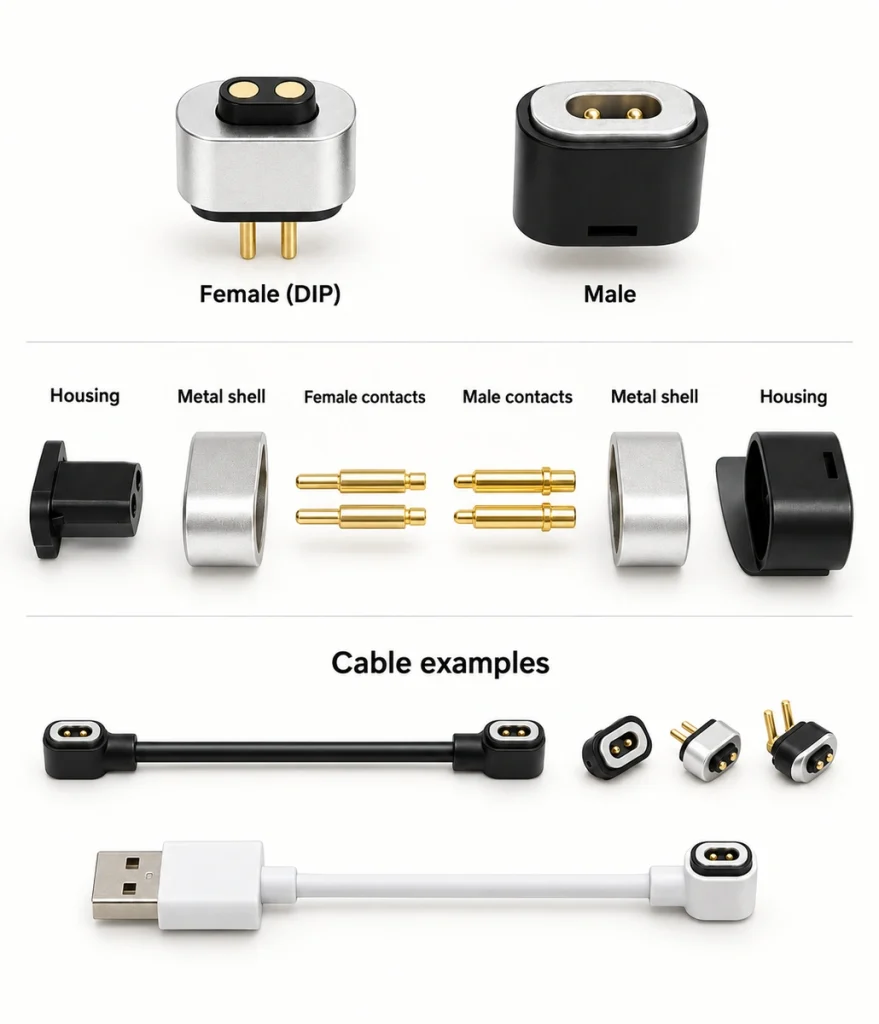
Four contacts alone do not establish USB data support. Specify the pinout for the required function and use the USB specifications published by USB-IF when designing a standardized USB power or data interface.
USB-IFUSB specificationsPin Count and Charging Performance
Additional contacts do not necessarily increase charging speed.
Current rating, contact resistance, pin size, wire gauge, length, voltage, PCB design and temperature rise all affect charging. A suitably designed two-contact cable may carry more current than a smaller four-contact version.
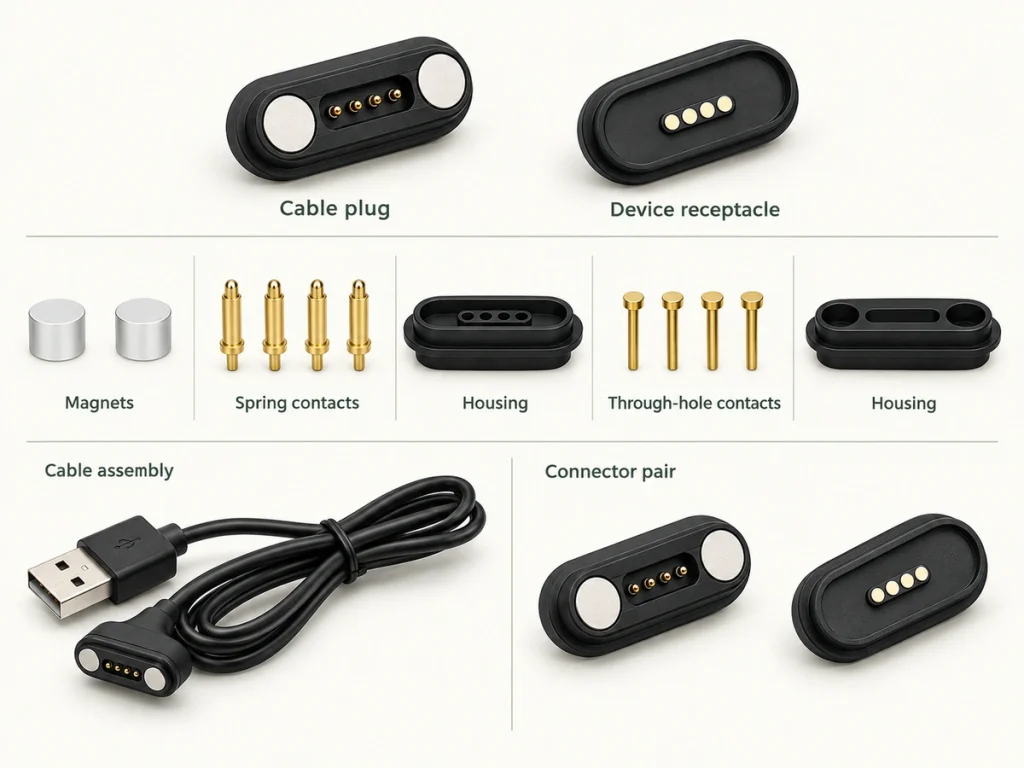
Assess current capacity from the specific connector's specifications rather than infer it from contact count.
Adding Data, ID and Signal Functions
Two additional paths give a four-contact design more options for data transfer, ID recognition, docking detection, sensing or control.
Power + Ground alone may need only two contacts. A system needing Power + Ground + ID + Detection may be better served by four.
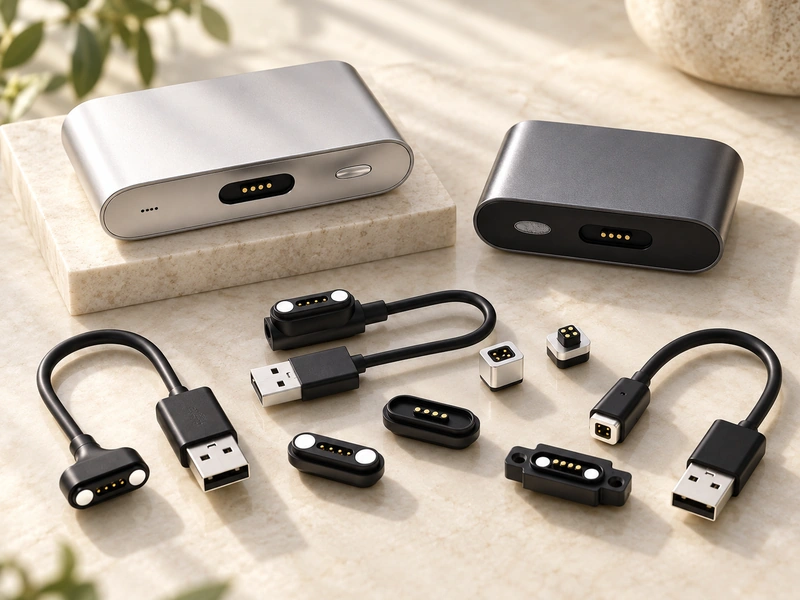
A product needing further electrical functions may require more contacts. The Magtor Magnetic Cable Connector range includes layouts for power, charging, signals and custom integration.
MagtorMagnetic Cable ConnectorSpace, Cost and Integration Requirements
A two-contact cable generally uses fewer contacts and wires and simpler PCB routing, which can suit compact wearables, sensors and small rechargeable devices.
Four contacts need additional routing and wiring, but do not necessarily require a larger head. A suitably small pitch can still produce a compact layout.
Two-contact layouts are generally simpler; four contacts offer more electrical options. Cost also depends on size, current, construction, water protection, plating and customization.
Selecting the Required Contact Count
Consider two contacts where a compact interface only needs power and ground. Wearables, sensors, trackers and other charging-focused products are examples.
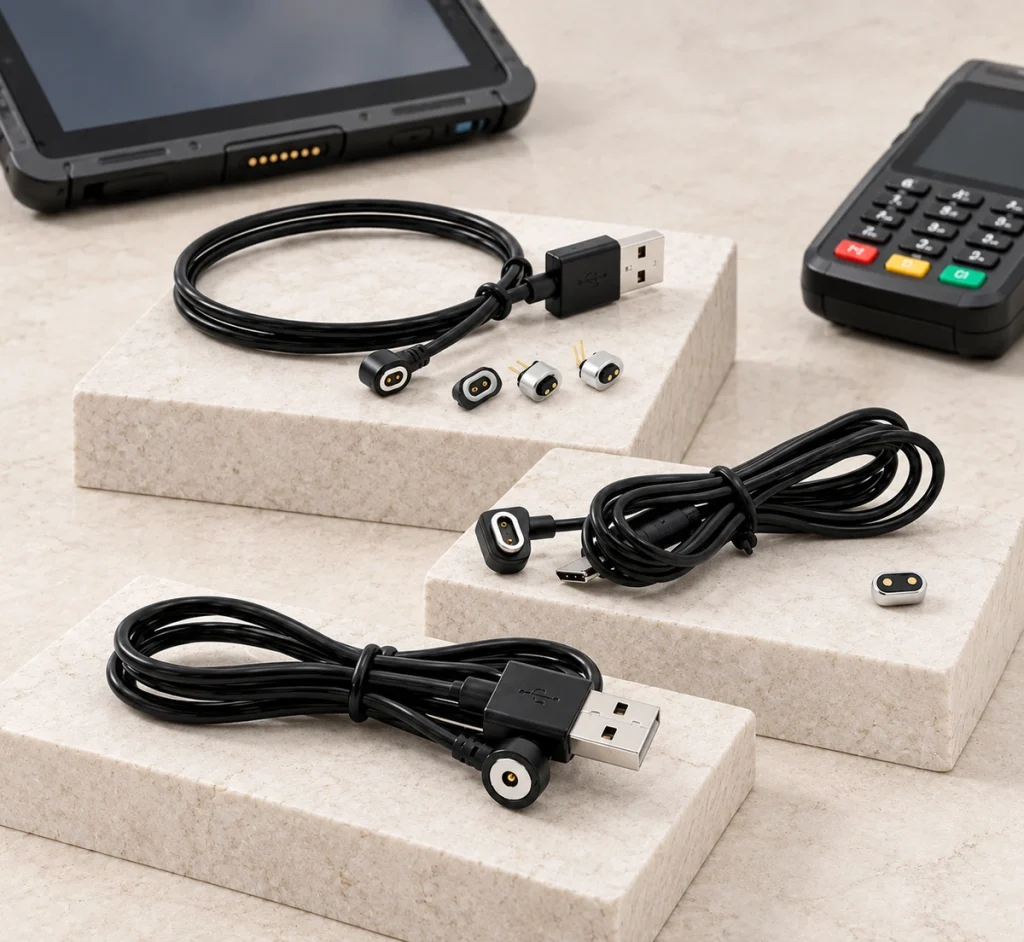
Consider four when the interface must also carry data, ID detection, control or another signal.
The design distinction can be summarized as:
2 Pin: a simpler charging interface; 4 Pin: charging with additional electrical functions.
Before approval, check pitch, polarity, voltage, current, dimensions, contact resistance, length and wire gauge together.
Select the layout that provides the product's required functions, using additional pins only where those functions call for them.
Matching Functions to Contacts
The required functions guide the two-versus-four choice. Two contacts usually suit power-and-ground charging; four can add data, ID detection, control or other signal paths.
Neither count is a universal answer. Also assess pitch, polarity, current, voltage, size, PCB space, cable length and wire gauge for the device.