
Magnetic or Standard Pogo-Pin Connector: Comparing the Complete Interface
Published on August 11, 2026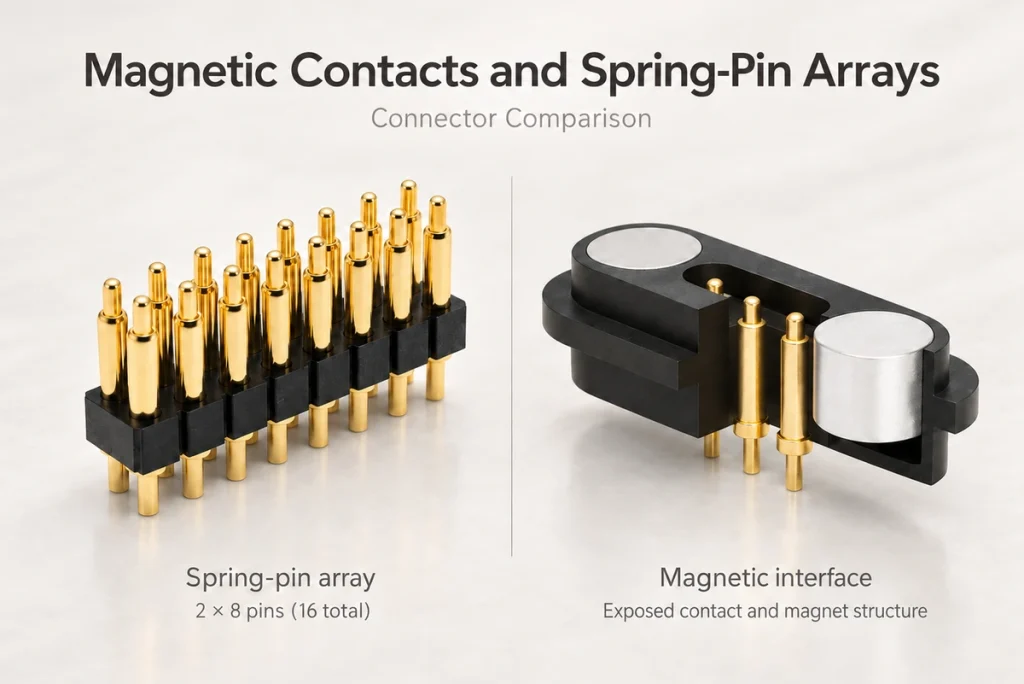
- Spring contacts with magnetic retention
- Spring contacts without magnets
- Alignment and retention compared
- Benefits and design trade-offs
- Matching the connection to the user’s routine
Both designs use spring contacts to conduct electricity. A magnetic version adds guided attraction and retention, while a standard version uses housing features or another mechanical structure to locate and hold the pair. Compare the actual alignment, loads and validation results rather than assuming magnets always improve vibration performance.
Magnetic spring-contact designsSpring contacts with magnetic retention
A magnetic pogo-pin interface combines spring contacts with magnets that assist engagement and retention. It can suit quick attachment in consumer, medical or industrial products where the complete assembly meets the relevant operating and safety requirements.
Operating principle: Embedded magnets assist approach and holding, with housing geometry and polarity establishing the correct contact position.
Structure: Spring-loaded contacts, magnets and an insulating or protective housing form the interface. The contacts carry current; the magnets serve the mechanical function.
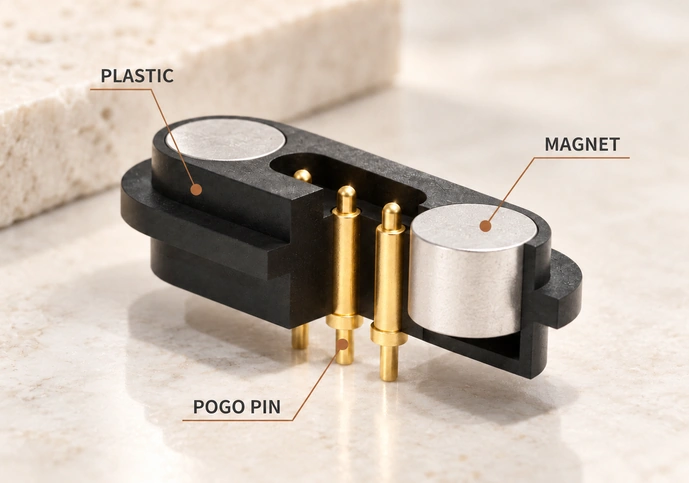
Related Terms:
Pogo pin: A spring-loaded conductive contact used at a mating interface.
Pogo pinMagnetic force: Attraction or repulsion arising from the magnet arrangement.
Magnetic force
Spring contacts without magnets
A standard pogo-pin assembly provides compliant electrical contacts without integral magnets. It can be used in testing, charging and other interfaces, including moving applications where appropriate positioning and retention are provided elsewhere.
Operating principle: A spring applies contact force over its specified working travel. Correct compression and alignment are needed to maintain the conductive path.
Structure: A plunger moves within a barrel under spring force. Gold, nickel or other specified finishes may be used; their suitability depends on the plating stack and exposure.
Video material pending replacement
Related Terms:
Electrical contact: A conductive interface that completes the intended circuit.
Electrical contactGold plating: A specified gold finish can help control corrosion and contact resistance; its performance depends on thickness, underlying layers and wear conditions.
Gold plating
Alignment and retention compared
Magnets assist approach and hold the magnetic pair together. Mechanical geometry, polarity and the force balance still determine correct alignment and compression.
Without magnets, guide features, housings, fixtures, screws or another applied mechanical load locate and retain the pair. Spring contact force must be balanced by that retaining structure.
| Feature/Aspect | Magnetic Pogo Pin Connector | Standard Pogo Pin Connector |
|---|---|---|
| Connection Security | Magnets provide retention, subject to the application’s loads | External structure balances the spring reaction and holds the interface closed |
| Ease of Alignment | Magnetic guidance with suitable geometry and polarity | Guides or other mechanical positioning establish alignment |
| Applications | Portable or repeatedly connected interfaces; vibration requires validation | Fixed or moving interfaces with suitable external retention |
| Cost | Magnets and their assembly can add cost | Cost depends on the contacts and external retaining structure |
Scroll horizontally to view every column.
Design note: For frequent attachment, magnetic guidance may reduce handling effort. For vibration, test contact continuity, working travel and retention in the actual assembly. Either design can be appropriate when those requirements are met.
Benefits and design trade-offs
| Feature | Magnetic Pogo Pin Connector | Standard Pogo Pin Connector |
|---|---|---|
| Durability | Depends on contact design, finish, load and test conditions | Depends on contact design, finish, load and test conditions |
| Ease of Use | Guided attachment may reduce user effort | Depends on the guide and retaining mechanism |
| Cost Efficiency | Assess magnets, housing and assembly in the quotation | Assess contacts and the required external retention |
| Application Scope | Useful where magnetic attachment serves a defined purpose | Useful across interfaces with a suitable mechanical support design |
Scroll horizontally to view every column.
Matching the connection to the user’s routine
When the halves approach within the designed capture range, the magnets can assist positioning. Correct polarity and housing features remain necessary to align the contacts.
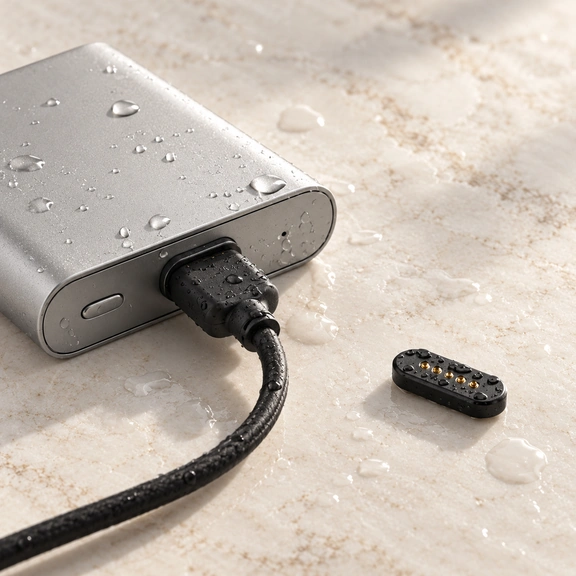
That can help frequent charging or blind engagement where the user should not need to insert a plug.
A nonmagnetic design can work well with existing guides or a fixed dock. Its contact travel and retaining mechanism must accommodate the actual positional tolerance.
In a wearable, medical device or portable product, guided magnetic attachment can be convenient. Confirm that benefit against the product’s handling and safety requirements.
Conclusion
Choose magnetic retention where it provides useful guided attachment or release behaviour. Choose standard spring contacts where an existing mechanical structure already locates and retains the interface. Compare cost, operating loads and verified performance for the actual designs.
Frequently asked questions
1. Does adding magnets increase cost? Magnets and their assembly can add material and process cost, but the total comparison also includes housings, external retainers, tooling and volume. Obtain quotations for equivalent requirements.
2. Can standard pogo contacts operate under high vibration? Yes, with suitable retention, alignment, compression and validation. Neither a standard nor magnetic structure has a universal vibration advantage without a comparable test.
3. Which products can use magnetic spring contacts? Consumer electronics, medical equipment and industrial automation are possible application areas where quick guided attachment is useful. The chosen interface still needs the relevant product validation.
4. How should I choose? Review the environment, connection frequency, alignment and retention requirements, user handling and budget. Compare actual electrical continuity, life and mechanical performance under the intended conditions instead of dividing applications into magnetic “dynamic” and nonmagnetic “static” categories.