
Choosing a Waterproof Magnetic Connector for the Complete Device
Published on August 11, 2026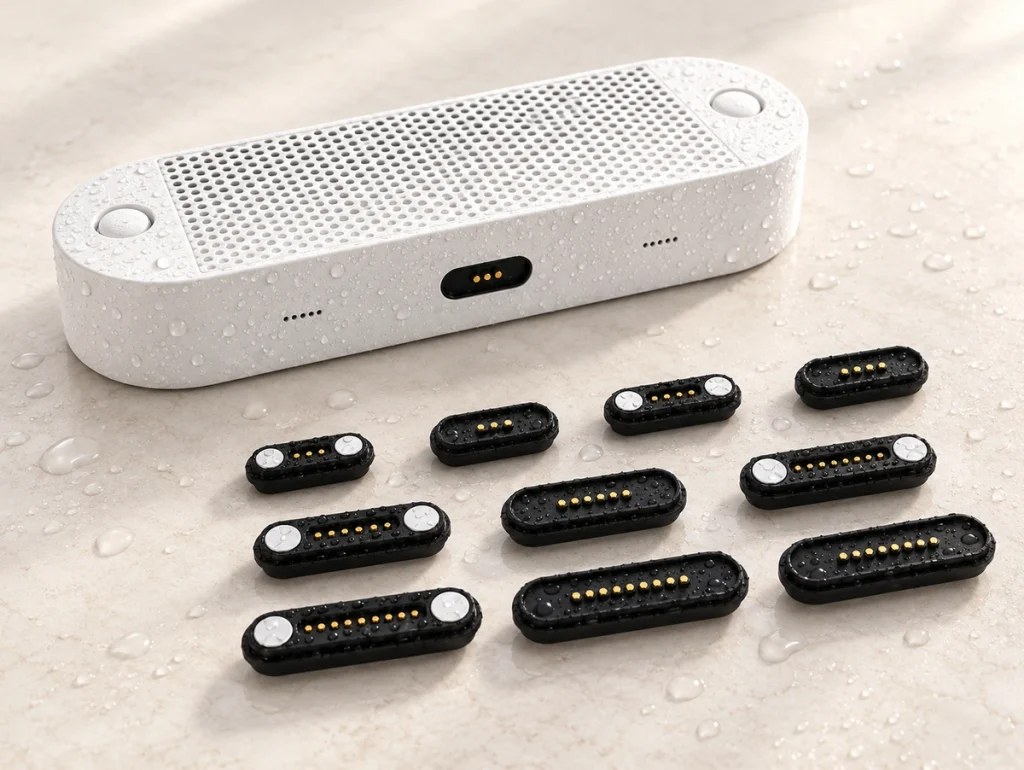
- Electrical and mechanical specification checks
- Choosing the required IP conditions
- Selecting a seal arrangement
- Matching the design to its environment
- Standard or sealed magnetic interface?
- When to develop a custom interface
Select a sealed magnetic interface by reviewing its electrical requirements, ingress conditions, seals, operating exposure and installation together. This guide explains the inputs needed to compare an existing part with a custom design.
sealed magnetic interfaceElectrical and mechanical specification checks
Begin with the device’s full electrical and mechanical requirements.
Allocate each contact before choosing the count. Charging power needs a positive path and return; detection, communication or data may require more contacts according to the circuit. Extra functions do not imply a universal pinout or protocol.
Review current and voltage, contact pitch and resistance, retention force, working height and mating-life target as a coordinated specification.
A wearable may favour compact packaging and manageable removal force; an industrial terminal may need greater resistance to vibration. Current requirements also influence contact diameter, PCB conductors, wire gauge and heat dissipation.
Check the installation as well:
Available connector length, width, and height
PCB position
Device wall thickness
Mounting structure
Cable outlet direction
Required mating cycles
The listed Magtor sealed families include three, four, five, six, eight and nine contacts. Many standard examples specify 3 A, IP65–IP67 and more than 10,000 complete mating cycles. Confirm the particular model and test conditions; custom OEM requirements may need a different configuration.
magnetic interfaceLook for a match to the electrical, mechanical and environmental requirements. The smallest housing or largest IP number alone is not a sufficient selection rule.
Choosing the required IP conditions
Specify the ingress requirement from the finished device’s actual water and dust exposure.
ingress requirement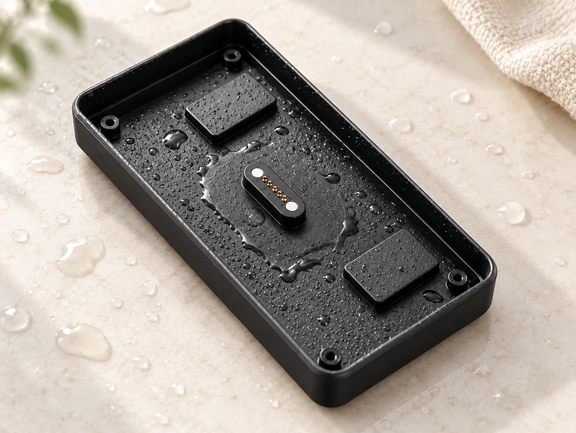
IEC 60529 supplies the IP Code framework for electrical-enclosure protection against solid objects and water, under defined test conditions.
IEC 60529Consider the required exposure:
| IP Level | Protection to assess under the declared test conditions |
|---|---|
| IP65 | Dust-tight protection and specified water jets; assess other outdoor exposure separately |
| IP67 | Dust-tight protection and specified temporary immersion |
| IP68 | Dust-tight protection and more demanding immersion under agreed conditions |
Scroll horizontally to view every column.
Do not specify IP68 solely because its number is higher. Confirm the actual depth, time and other declared conditions without assuming every IP68 product is identical.
A more demanding seal requirement can affect size, seal geometry, moulding, assembly tolerances, tooling and validation scope. Compare the design consequences against the actual exposure.
Evaluate the complete assembly. Water can enter through the connector-to-enclosure interface even when the connector’s own seal is effective.
The standard design range primarily addresses IP65–IP67. A custom Magtor project can target conditions in the IP65–IP68 range, subject to housing, seals and validation; that is not an existing certificate for every configuration.
Before choosing the rating, ask:
Will it encounter sweat, rain, jets, temporary immersion, repeated cleaning or prolonged water exposure?
Use those conditions to define separate ingress and corrosion requirements.
Selecting a seal arrangement
Sealing the visible outer surface alone does not establish protection through the full interface.
Review every water path from the external contact area to the PCB and other internal parts.
PCBPossible sealing methods include:
- O-rings
Sealing grooves
Insert molding
Overmolding
Potting
Adhesive sealing
Housing compression structures
A Magtor design review can coordinate seal grooves, working height, housing dimensions, mounting holes, PCB position and cable exit with the actual device enclosure.
MagtorO-Ring Sealing
An O-ring can seal an interface where the assembly provides controlled compression against the housing.
Its effectiveness depends on groove geometry, compression, surface finish and tolerance control. Assess assembly and service access without assuming a universal compression ratio.
Insert Molding or Overmolding
Insert moulding or overmoulding can form an integrated structure around a connector or cable, where the material interfaces bond and seal adequately.
It may reduce gaps or assembly steps in a compact part or cable assembly, but the achieved seal still needs validation.
Potting and Adhesive Sealing
Potting or adhesive can interrupt internal water paths to the PCB where the materials and interfaces are suitable.
Review dispensing consistency, cure process, repairability and long-term material compatibility before selecting the compound.
Plan the seals with the enclosure from the start of a compact-product project.
Adding seals late can increase thickness, interfere with appearance or leave difficult assembly tolerances. Resolve those constraints before freezing the housing.
A useful design rule is:
Treat the contact assembly, seal arrangement and enclosure as one interface, with coordinated dimensions and tolerances.
Matching the design to its environment
Actual exposure is a key input to the structure and finish selection.
Different applications create different degradation mechanisms.
Wearable Devices
Watches, fitness trackers, hearing-related products and wearable medical equipment can expose the interface to sweat. Those application examples do not establish medical or skin-contact approval.
For a wearable, review:
Sweat resistance
Contact plating
Small connector dimensions
Frequent charging cycles
Skin-contact requirements
Easy magnetic alignment
Outdoor Electronics
Outdoor trackers, sensors, cameras and shared-mobility devices can encounter rain, humidity, dust and temperature changes. Define the exposure for the intended location.
Ingress and corrosion requirements may outweigh a small footprint in those applications. Make that trade-off against the actual specification.
Medical and Healthcare Devices
Medical equipment may be wiped repeatedly with specified cleaners or disinfectants.
Select seals and contact materials for the device’s chemicals and cleaning procedure. An IP result does not establish resistance to every disinfectant.
Industrial Equipment
Factory terminals, scanners, robots and automation interfaces may face dust, oil, vibration and impact, each requiring a defined assessment.
The assembly may need stronger retention and structural support to prevent unwanted separation. Evaluate actual load direction and release effort as well as magnet attraction.
Cleaning Equipment
Robot vacuums, smart mops and related equipment can expose the interface to water and cleaning fluids. Specify the permitted cleaning conditions.
Where moisture collects around the charging area, examine the connector-to-housing seal alongside contact corrosion and power-control requirements.
Magtor considers sealed-interface designs for wearables, outdoor, medical, industrial and cleaning equipment, vehicle-related charging interfaces, smart-home products and docks. These are application areas rather than evidence of qualification, third-party supply or high-voltage vehicle-charging capability.
Alongside the IP question, ask:
“What exposure will the interface see throughout the intended service life?”
Include water, sweat, salt, dust, oil, cleaning products, vibration, temperature and the expected mating frequency.
Standard or sealed magnetic interface?
A dedicated waterproof design is not necessary for every application.
A standard interface may suit a specified dry, controlled indoor environment. Dedicated O-rings, seal grooves or moulded seals may be unnecessary, but the relevant electrical, mechanical and environmental requirements still need assessment.
A sealed version is worth evaluating when water or contamination creates a significant risk, with the actual exposure and installation defined.
| Factor | Standard Magnetic Connector | Waterproof Magnetic Connector |
|---|---|---|
| Environment | Specified dry indoor exposure | Specified wet, dusty or demanding exposure |
| Water Protection | As declared for the selected design | Dedicated sealing design |
| Housing Integration | Depends on the mounting and enclosure | Sealing interfaces matched to the enclosure |
| Sealing | As needed for the application | O-ring, molding, potting, etc. |
| Corrosion Requirement | Defined by the actual dry exposure | Defined separately for the actual wet or corrosive exposure |
| Testing | Electrical and mechanical, plus relevant environmental assessment | Electrical, mechanical and the specified ingress/exposure tests |
| Customization | Project-dependent | Often requires an application-specific seal and housing |
| Cost | Depends on construction, tooling and volume | Additional seals or controls can increase cost |
Scroll horizontally to view every column.
A standard Magtor interface can serve its specified dry environment. A sealed design adds the housing integration and seal structure needed for the declared exposure, which may include rain, sweat, dust or cleaners. Each exposure needs the relevant validation rather than an assumption from the product category.
That distinction helps keep the specification appropriate to the product.
In a dry indoor product, unnecessary seals can add tooling and assembly costs without addressing a real risk. Review the likely exposure before adding complexity.
Conversely, an unsuitable unsealed interface in a wet wearable, outdoor or cleaning product may suffer corrosion, rising resistance, interrupted charging or leakage.
Balance the cost against the actual environmental risk and the required validation.
When to develop a custom interface
Use a standard part where its dimensions, contact arrangement, current limits and seal method all match the application.
A compact or specialised enclosure may instead require a custom layout.
Consider a custom design when:
The available housing space is limited
A specific pin layout is required
Power and signals must share one connector
Standard magnetic force is unsuitable
The connector must match existing mounting holes
A specific cable outlet direction is required
Higher waterproof protection is needed
Special plating is required for sweat or corrosion resistance
The connector height affects the industrial design
Magtor can review contact count and functions, magnet force and layout, housing size and height, mounting, cable length and exit, seal method, electrical limits and plating. The project can proceed through drawings, structural recommendations, sample approval, validation and production release; sample approval does not replace the agreed tests.
For that review, provide:
Application: Identify the wearable, medical device, outdoor product, robot, dock or other equipment.
Envelope and drawing: Include mounting holes, housing thickness, PCB position and the permitted interface height.
Pinout: Assign power, ground, signal, detection and data contacts.
Electrical requirements: Specify voltage and both continuous and peak current where applicable.
Ingress target: State the required IP65, IP67 or IP68 exposure conditions.
Environment: Describe water, sweat, salt spray, cleaners, dust, oil, vibration and temperature.
Life target: Estimate complete connection-and-removal cycles under the intended use.
Cable: Define length, wire gauge, termination and exit direction.
These inputs allow a seal and contact structure to be developed around the device’s real constraints, instead of adapting the enclosure to an unsuitable catalogue part.
Conclusion
Review electrical performance, ingress conditions, seals, mechanical integration, exposure and customisation together when choosing a waterproof magnetic interface.
Define the application, pin functions, voltage and current, ingress requirements, space and life target first. Compare O-rings, moulded seals, potting or other approaches against the actual enclosure and exposure.
A standard part may suit a simple dry indoor design. Moisture or contamination in wearables, outdoor, medical, industrial or cleaning products can call for a sealed solution, engineered and validated for that specific environment.
When catalogue parts cannot satisfy the envelope or exposure, a custom interface can coordinate contacts, housing, magnetic force, seals, spring structure, finish and cable around the complete product.