
Magnetic Charging for Smart Mugs: Benefits and Design Checks
Published on June 9, 2026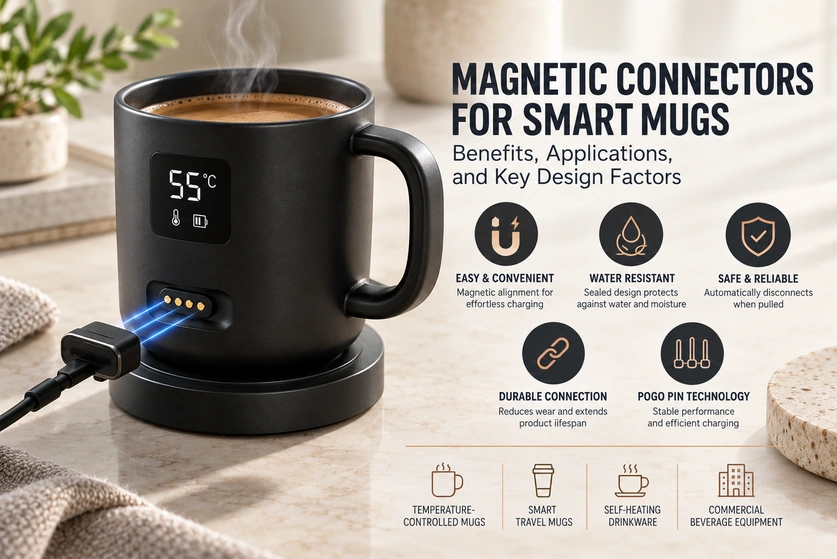
- How Magnetic Charging Contacts Work
- Reasons to Consider a Magnetic Mug Interface
- Smart-mug Application Examples
- Requirements for the Charging Interface
- Possible Development Priorities
A smart mug’s charging interface must fit everyday handling as well as the electrical and exposure requirements. Magnetic designs can simplify attachment and support a sealed device-side arrangement. This guide explains their operating principle, potential advantages, application examples and the design checks needed for the complete mug and charger.
How Magnetic Charging Contacts Work
Magnets guide a charging head or dock toward its intended mating position. Once aligned, the electrical contacts engage and carry power between the charger and device. The magnetic arrangement provides guidance and retention; it does not transfer electricity wirelessly or independently establish charging safety.
magnetic connector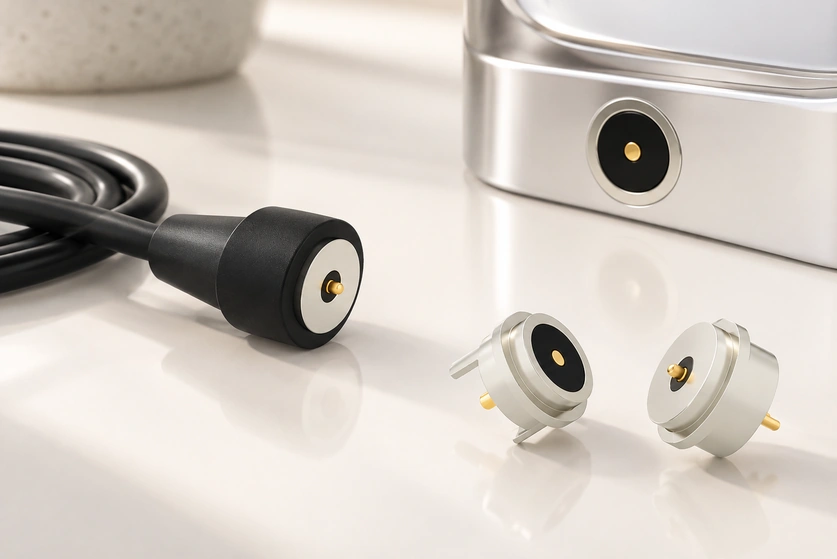
A two-contact magnetic interface can provide the positive and return paths for a mug charging dock. This lets users place and remove the mug without aligning an insertion-style plug, provided the dock geometry and contacts locate reliably. Power delivery must still be designed and tested for the chosen mug and charger; two contacts alone do not prove safe or efficient charging.
two-contact magnetic connectorReasons to Consider a Magnetic Mug Interface
Convenient Everyday Attachment
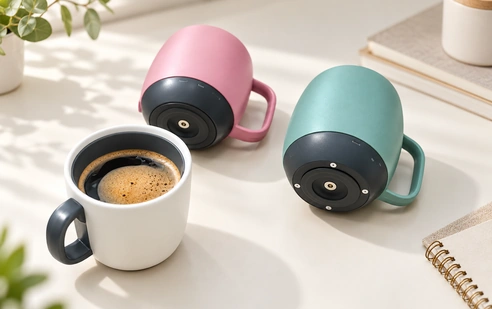
A mug used every day may need frequent charging. A magnetic dock or cable head can make attachment straightforward by guiding the mating surfaces when the user places the mug or brings the charging head to the interface.
Potential handling benefits include:
Convenient one-handed placement where the product geometry supports it.
Magnetic alignment assistance.
Quick attachment and removal.
Less effort spent aligning a charging plug.
Those handling features may be useful at home, in an office or hotel, and during travel.
A Sealed Device-side Arrangement
A magnetic face-contact interface can be integrated into a sealed structure without an open insertion port. Water and moisture protection depends on that structure and its verified assembly state; magnetic guidance itself is not a seal.
The exposure review for smart mugs should include:
Hot-liquid spills.
Steam.
Condensation.
The specified cleaning routine.
A suitable sealing design and compatible materials can improve reliability under those defined conditions. Confirm the complete product’s cleaning and exposure limits rather than assuming that a sealed charging interface permits any washing method.
Less Insertion-related Wear
Repeated insertion of a conventional charging plug places mechanical loads on its port. Possible wear-related problems include:
A loose connection.
Damaged terminals.
Port distortion.
Deteriorating charging contact.
A magnetic face-contact design avoids some insertion friction, although its contacts still compress and wear. Suitable assemblies may target tens of thousands of mating cycles, with specialized designs targeting hundreds of thousands. Validate the specific contact structure and operating conditions before using either example as a life requirement.
Controlled Cable Release
A magnetic cable connection can be designed to release when pulled, reducing the load transmitted to the mug or port. Check the release force and direction against normal use and foreseeable cable pulls.
A validated breakaway arrangement may help:
Reduce connector breakage under cable pulls.
Limit related repair needs.
Reduce pull-related user hazards in the intended arrangement.
Reduce mechanical loads on internal electronics.
Smart-mug Application Examples
Temperature-controlled Coffee Mugs
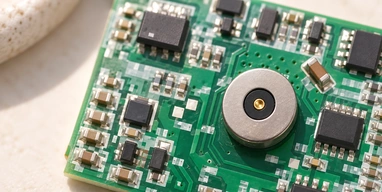
A heated mug may contain a rechargeable battery and a temperature-control circuit. Magnetic contacts can provide a convenient charging interface while allowing an uncluttered external shape, subject to the battery system and enclosure requirements.
Smart Travel Mugs
Travel mugs need a compact charging arrangement suited to repeated handling. A magnetic design can meet that need when its exposed faces, sealing and materials are appropriate for the expected dust and moisture.
Self-heating Drink Containers
Self-heating drinkware used in offices, vehicles or outdoor settings may benefit from easy repeated charging. The interface must be chosen for the actual current, mounting and exposure in each setting.
Commercial Beverage Products
For some hospitality or commercial beverage products, a magnetic interface can simplify charger attachment and servicing. Evaluate the maintenance routine and loaded charging performance rather than assuming a general increase in electrical efficiency.
Requirements for the Charging Interface
Water Protection
Water, steam and cleaning exposure make sealing an important part of smart-mug integration.
Review these features in the assembled product:
The sealing arrangement.
Enclosure materials.
Protection of the contact paths.
The environmental test requirements.
An application may specify IP65, IP67 or a higher protection level. The relevant test, protected components and mated or unmated state must be defined; an IP label does not cover every hot-liquid or cleaning condition automatically.
Contact Stability
Consistent charging requires the connection to maintain suitably low contact resistance.
The contact review should address:
The selected pogo-contact structure and quality.
Consistency of spring force.
Contact-coating materials.
Resistance to the specified corrosion exposure.
Spilled beverages can leave residue on the contact face or contribute to corrosion over time. Choose and validate a plating system for that exposure, and specify an appropriate cleaning method so residue does not become an insulating barrier.
Magnetic Retention
Holding force needs to suit both stable docking and user removal.
Too little force may allow unstable charging, while too much can make removal awkward. Evaluate retention with the mug’s weight, charging orientation and expected handling, then test the chosen magnetic arrangement in the final structure.
Charging Current
The required charging current depends on battery size and the intended charging behavior, so different mugs may need different contact paths.
Illustrative current targets include:
1A charging.
2A charging.
Designs above 3A where the charging system and connector support that load.
Match the connector’s verified electrical performance to the product requirements; a current value alone does not establish charging speed.
Material and Documentation Requirements
Review materials against the applicable environmental and safety requirements for the consumer product. Documentation categories to discuss include the following, while keeping product material compliance separate from organization-management certification:
- Applicable RoHS material compliance evidence.
Applicable REACH substance documentation.
ISO 9001 and ISO 14001 management-system documentation for the relevant organization and scope.
ISO 9001ISO 14001
Possible Development Priorities
Further smart-drinkware design work may focus on the following requirements. These are possible engineering priorities, rather than a forecast of market adoption or proof that a particular connector already provides them:
Higher validated charging-current capacity.
More compact connector geometry.
Improved protection for the defined water exposure.
Better resistance to the relevant corrosion conditions.
Additional data paths and supported communication functions.
A custom magnetic interface may help a manufacturer meet its appearance, durability and handling goals when a standard design does not fit. Its proposed advantages should be checked against the complete product requirements.
Conclusion
Magnetic contacts are an option for temperature-controlled mugs, travel mugs and other rechargeable drinkware. Convenient attachment, an appropriate sealed structure and a controlled cable-release design can be useful, but none of those benefits is automatic for every model.
Define water and cleaning exposure, contact stability, magnetic force, charging current and materials together. Then validate the mug and charger as an assembled system. This gives product teams a basis for dependable charging and everyday handling without treating the interface as a guarantee of drinking safety, washability or service life.