
Magnetic Connector Applications: Industries and Design Trade-offs
Published on May 29, 2026
- How a Magnetic Connector Makes Contact
- Industries and Example Applications
- Practical Benefits of Magnetic Connections
- Deciding Whether a Magnetic Interface Fits
Consumer electronics, medical devices, industrial equipment and automotive systems can all use magnetic connections. Quick engagement and reduced port wear make them useful in compact products that connect and disconnect frequently, provided the interface is designed for the required power, signals and operating conditions.
Magnetic connectorHow a Magnetic Connector Makes Contact
A magnetic connector uses magnets to guide the mating halves into alignment and retain the joint. Electrical power or data passes through the contacts, with the contact arrangement providing the necessary pressure. Compared with an inserted plug, the approach can limit mechanical wear, simplify connection and accommodate a sealed enclosure, particularly in compact or demanding-use products.
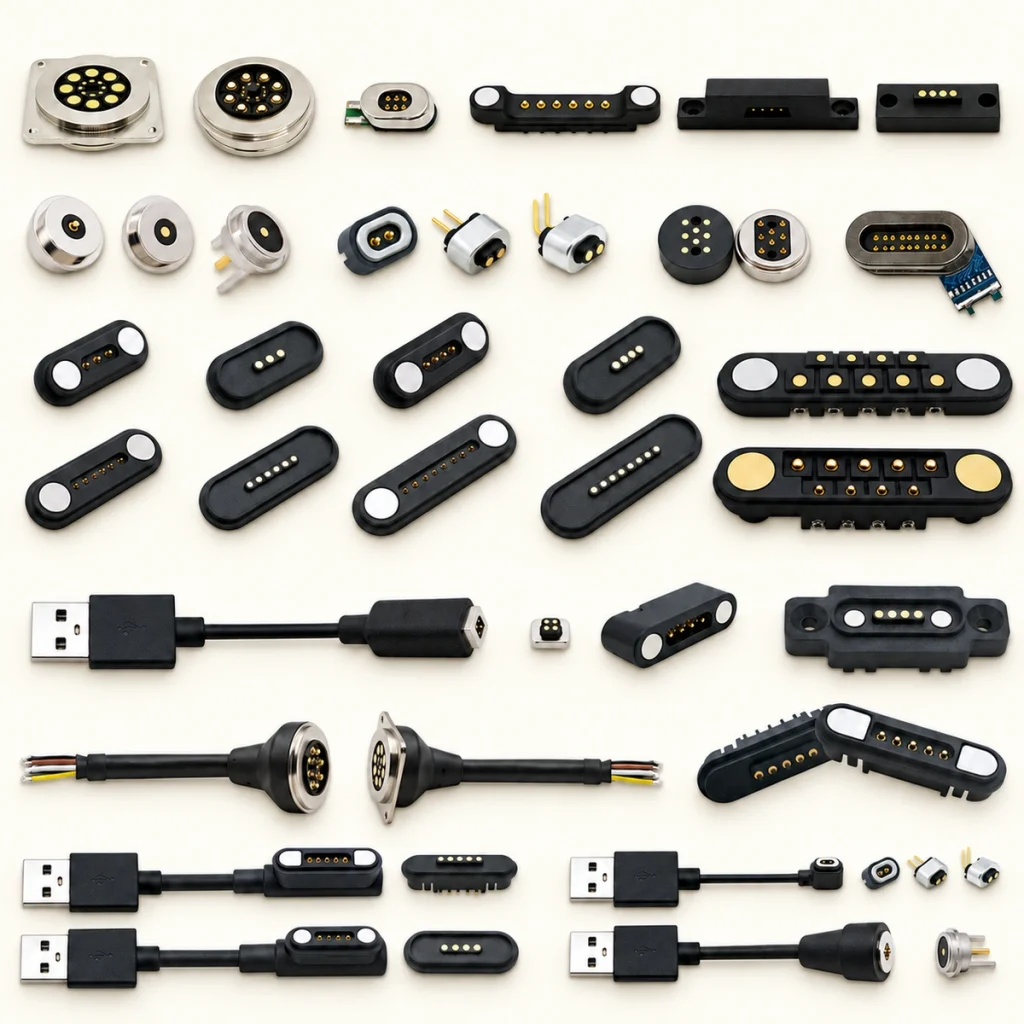
Typical Interface Arrangements
Magnetic charging connectors — a widely used arrangement for charging interfaces; compatibility still depends on the particular design.
Magnetic cable connectors — generally used for power and data, with the female side fitted to the device and the male connector integrated into the cable.
Magnetic pogo-pin docks — shaped to fit the device enclosure and provide a more mechanically supported docking interface.
Connection Sequence and Operating Principle
The interface normally has a male and a female half. Magnets and plastic housing features align spring-loaded or flat contacts. This arrangement is useful when users make frequent connections or when a conventional open port would make enclosure sealing more difficult.
A Typical Mating Sequence
Approach — bring the halves close enough for magnetic attraction to begin.
Alignment — the magnets guide the plug toward the receptacle, reducing the precision required from the user.
Contact — pogo pins compress against mating pads to complete the electrical path.
Retention — magnetic force and friction resist pull-off within the specified limits of the design.
Release — a lateral or direct pull separates the interface; a suitable release design can reduce damage compared with a rigid connection.
Design Features That Affect Performance
Magnet grade and dimensions: holding force and tolerance of misalignment.
Contact style: insertion-type mating or an arrangement suited to lateral mating and release forces.
Plating: gold thickness, coating material and corrosion resistance.
Pin count and assignment: power, data, detection, grounding and shielding.
Ingress protection: gaskets, overmolding, potting and the sealed receptacle design.
Design note: quick connection and a flexible housing structure make magnetic interfaces suitable for many product types. Tooling can be economical for a particular project, but any cost advantage should be evaluated against the chosen design and production quantity.
Industries and Example Applications

Consumer Electronics
Example products include smartphones, tablets, AI smart glasses, Bluetooth earphones, smartwatches, gaming accessories and portable charging equipment. Magnetic alignment can make connection more convenient and reduce the damage associated with incorrect insertion.
Wearable Electronics
Wearables often need a small interface that tolerates corrosion and sweat exposure. Fitness bands, health monitors, VR headsets and AR glasses can use magnetic pogo-pin connectors to support compact layouts and dependable charging when those environmental requirements are validated.
Medical Equipment
Portable monitors, beauty devices, rehabilitation equipment and handheld diagnostic instruments are examples of products that can use pogo-pin interfaces. The connector can simplify handling and cleaning while supporting stable electrical contact; the complete device still needs its applicable safety and validation work.
Automotive and New-energy Products
Automotive electronics, EV accessories, intelligent interior modules, navigation systems and charging equipment are possible applications. A high-current magnetic design can carry the required power only when its contacts, thermal performance and environmental protection have been specified for the load.
High-current magnetic connectorSmart Home Products
Smart locks, desk lamps, smart speakers, security equipment and products that include wireless charging can use magnetic connectors for their relevant physical interfaces. The goal is easier installation and operation; a magnetic electrical contact itself still transfers current through physical contacts.
Industrial Equipment and Robotics
Industrial automation and robots can benefit from high-current magnetic interfaces where fast connection, simpler maintenance and frequent motion are involved. Specify the current, retention and mechanical operating conditions needed to achieve reliable contact.
Outdoor and Water-resistant Equipment
GPS trackers, marine electronics, outdoor lights, drones and portable communication devices are examples where environmental protection matters. Their magnetic interface needs an IP-rated sealing strategy verified on the relevant assembled and mating state.
Shared Equipment and Charging Systems
Shared power banks, docks, self-service terminals and public charging systems are potential applications for magnetic connections. Frequent mating and straightforward replacement are useful design goals, with the required cycle life verified for the actual assembly.
Aerospace and Specialized Equipment
Custom magnetic interfaces may be considered for aerospace, military equipment and specialized communications where space, vibration and quick connection are important. Suitability depends on the project’s qualification requirements; the application example is not a sector approval for every connector.
Practical Benefits of Magnetic Connections
Fast mating, less port wear and planned breakaway behavior can improve the experience of using a magnetic interface. Fewer exposed openings can also support a cleaner industrial design and a sealed or partly sealed housing. Reducing bent pins and receptacle damage may help limit warranty problems, but the outcome depends on the complete product and its use.
Benefits Matched to the Application
The following qualitative comparison links each potential benefit to a typical use case; it does not represent a measured failure-rate or warranty dataset.
| Potential benefit | Design relevance | Example applications |
|---|---|---|
| Fast one-handed connection | Self-alignment can reduce mating errors | Wearables, bedside devices and handheld scanners |
| Less mechanical wear | Lower insertion force and fewer damaged ports | Frequently docked consumer devices and shared equipment |
| Breakaway behavior | Release at the designed load can reduce device damage | Retail POS, selected laptop/tablet designs and kiosks |
| A cleaner enclosure | Fewer open cavities and more sealing options | Medical enclosures, outdoor electronics and industrial sensors |
| Easier use with limited visibility | Magnetic guidance helps the mating halves find alignment | Vehicle interior accessories and service tools |
| Potentially better field reliability | Reduced stress on the PCB and port | Field equipment and rugged handheld products |
Scroll horizontally to view every column.
Design note: individual pogo pins can be arranged in different housings to create versatile interfaces. Tooling cost and development speed depend on the project. A magnetic design can be a useful general-purpose alternative, although it may not provide the specialized performance or interoperability of a dedicated connector.
Deciding Whether a Magnetic Interface Fits
Magnetic mating can provide a fast, tool-free connection while reducing alignment mistakes and wear. It is useful in confined spaces and can combine a low-profile sealed interface with planned breakaway behavior. Consumer, industrial and medical products that dock often should assess these benefits alongside their specific electrical and environmental requirements.
Advantages and Trade-offs Compared with Inserted Plugs
| Factor | Magnetic interfaces | Conventional inserted plugs |
|---|---|---|
| Mating speed | Often fast enough for one-handed connection | Usually slower and may need both hands |
| Alignment tolerance | Magnetic guidance reduces the precision needed for mating | More dependent on manual alignment |
| Wear and mating life | Can suit frequent docking when validated for the required cycles | Repeated insertion can progressively wear the interface |
| Cable-pull behavior | Designed breakaway can help prevent damage | A pull can load the port or move the device |
| Enclosure sealing | A sealed contact surface may be easier to integrate | Many designs leave an open port |
| Power capacity | Suitable for low to moderate loads; higher power needs careful thermal and contact design | Options cover a broad range, including very high power |
| Data and signal integrity | Possible when pin layout and shielding are engineered for the signal | Established options for high-speed interfaces |
| Sensitivity to debris | Exposed magnetic contacts can collect metal dust and need cleaning | Recessed or protected options are available |
Scroll horizontally to view every column.
Magnetic interfaces are attractive for repeated docking, restricted access and user-facing connections. Conventional connectors may be a better choice where maximum power, standardized interoperability or operation around heavy debris is the priority and the magnetic design lacks the necessary protection.
The reasons to consider magnetic mating are faster handling, easier alignment, lower wear and planned separation during repeated connection and release.
Choosing for the Complete Product
A magnetic interface fits best when quick mating, reduced wear and a controlled release improve the complete product. Selection should account for power and data, contact construction, plating, sealing and a realistic validation plan. For a new magnetic cable connection, Magtor can review the pin count, current and environmental targets to support selection and qualification.
Magtor